
Product Guide
Equipment Labels for Control Panels and Faceplates
A practical guide to laser-printable polyester labels for industrial equipment identification - including the Multicomp Pro® range manufactured by Silver Fox®.
Introduction
Why equipment labelling is more demanding than it looks
A faceplate label in a control room or substation needs to do several things at once: it must be legible under varied lighting, hold firm on a metal or plastic surface for years, tolerate the cleaning solvents used during routine maintenance, and resist moisture if the environment demands it. Get any of those wrong, and identification starts to fail - which creates real risk in safety-critical installations.
Ordinary office laser labels are not engineered for these conditions. They are designed for paper and card, not for powder-coated steel panels or polycarbonate faceplates. When the wrong material is used, labels yellow under UV exposure, peel back at the corners, or accept the print poorly - leaving faded, unreliable identification that creates more problems than it solves.
The Multicomp Pro® equipment label range, manufactured by Silver Fox® and distributed through Farnell, Newark, and Element14, addresses this gap with a laser-printable polyester material tested to industrial standards. This guide covers what makes these labels suitable for demanding equipment identification tasks, which environments they are designed for, and how to select the right size and print your own labels to a professional finish.
1. The product
Multicomp Pro® equipment labels: manufactured by Silver Fox®
Silver Fox® has been manufacturing identification products for industrial applications since 1979. The Multicomp Pro® equipment label range is part of a wider white-label manufacturing relationship with Farnell - one of the UK's leading electronics and industrial components distributors - that also covers cable and wire labels and label design software.
The equipment labels are produced on durable white polyester film with a specialist laser print receptive surface applied during manufacture. This surface is engineered to accept standard laser printer toner cleanly and permanently, producing crisp, high-contrast text, symbols, and barcodes that remain legible over the product's service life. The polyester base gives the labels dimensional stability - they will not stretch, shrink, or distort - and resistance to moisture, oils, and many common cleaning agents.
Adhesion uses a pressure-sensitive acrylic adhesive. Acrylic adhesives are chosen for equipment labelling because they develop strong, long-term bonds on both metal and plastic substrates, resist temperature cycling, and do not fail gradually in the way that rubber-based adhesives can over time. For best results, the application surface should be smooth, clean, and dry before the label is applied.
The complete Multicomp Pro® range, including equipment labels and Multicomp Pro® labelling software, is available from Farnell under the Multicomp Pro® brand.
2. Performance credentials
Material testing and performance standards
Specifying an equipment label on material credentials alone is insufficient. Labels need to survive the conditions of their installed environment - not just the moment of application. The Multicomp Pro® equipment labels have been tested to the following methods to validate real-world performance:
Low Temperature
MIL-STD-810F Method 502.4 - 72 hours at -40°C. Confirms the label and adhesive remain intact and legible after sustained exposure to extreme cold, relevant to outdoor enclosures and unheated plant rooms.
Elevated Temperature
MIL-STD-202G Method 108A - 2,000 hours at 70°C to 100°C. Validates performance in equipment panels that run hot, including power electronics, motor control centres, and switchgear.
UV Weathering
ISO 4982 Part 3 Method A Cycle 1 - 3,000 hours. Demonstrates resistance to UV-induced yellowing and surface degradation for labels in control boxes or equipment near windows. Note: the range is intended primarily for internal use; direct outdoor sunlight exposure is limited.
Hydrogen Sulphide and Salt Mist
H2S sour gas exposure (2% H2S) and IEC 60068-2-52 Test Kb salt mist (cyclic). These tests cover the corrosive atmospheres found in oil and gas facilities, coastal installations, and certain process environments where atmospheric contamination can degrade conventional labels rapidly.
These test conditions cover the majority of industrial indoor environments - control rooms, power stations, substations, and process plant - where equipment labels are most commonly required. For applications in direct outdoor UV exposure or immersion-risk environments, speak to Silver Fox® directly about the most appropriate labelling solution for the specific conditions.
Key storage requirements
- Store between 10°C and 25°C
- Keep in dark conditions away from direct light
- Maintain humidity between 35% and 65% RH
- Use stock in rotation to maximise adhesive performance
3. Applications
Where equipment labels are used
Polyester laser equipment labels are a practical choice wherever printed identification needs to be applied directly to equipment surfaces rather than to cables or pipes. The most common applications fall into three broad areas.
Control panels and switchgear
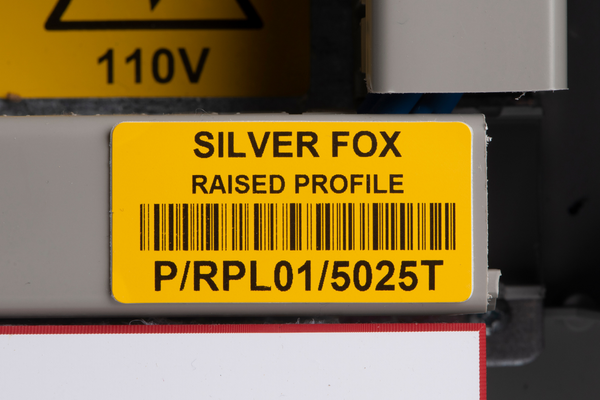
Labels applied to the face of control panels identify switches, pushbuttons, indicators, and isolators. In installations where engraved traffolyte legend plates are not specified - or where a fast, flexible, on-demand labelling solution is required - laser-printed polyester labels offer a clean, professional finish. Sizes from 48 x 9 mm work well for single-line switch legends, while wider formats suit combined function labels covering multiple controls.
Faceplates and outlets
Data centre faceplates, network wall outlets, patch panels, and audio-visual connection points all benefit from clear printed labels identifying port function, circuit number, or destination. Compact sizes such as 20 x 8 mm and 22 x 7 mm are well suited to the tight spacing found on standard faceplate formats. The pre-perforated sheet format makes dispensing individual labels fast during installation.
General equipment identification in substations, power stations, and process plant
In higher-voltage installations and process environments, equipment labelling forms part of the broader asset identification system. Labels identifying individual items of plant - transformers, circuit breakers, metering equipment, junction boxes - need to remain legible for extended periods in environments that can include temperature cycling, oil mist, and atmospheric contamination. The H2S and salt mist testing makes the Multicomp Pro® range appropriate for many of these applications, particularly in indoor or sheltered locations.
For assets requiring heavier-duty identification - valve tags, raised profile labels, or labels that must survive immersion or abrasion - contact Silver Fox® directly to discuss the appropriate material options for more severe conditions.
4. Specification
Choosing the right size
The Multicomp Pro® equipment label range covers seven standard formats on A4 sheets, with labels pre-perforated for rapid removal. Selecting the correct format starts with measuring the available space on the target surface and accounting for the text or barcode content that needs to fit.
Compact formats
17 x 9 mm (308/sheet), 20 x 8 mm (270/sheet), 22 x 7 mm (288/sheet), 24 x 12 mm (160/sheet). Suitable for outlet faceplates, terminal identification, and labelling where space is very limited. High label count per pack suits large-volume projects.
Mid-range formats
48 x 9 mm (112/sheet). The standard format for single-line control legends, switch identification, and panel labels where a longer text description is needed in a narrow profile.
Larger formats
55 x 22 mm (33/sheet) and 297 x 210 mm (A4, 1/sheet). Suitable for equipment nameplates, warning notices, larger asset identification labels, and safety information panels where more content needs to be displayed clearly.
When planning a labelling project, it is worth considering not just the immediate application but also future re-labelling needs. Standardising on one or two label sizes across a facility reduces stock complexity and simplifies the reprinting process when equipment is modified or re-assigned.
5. Printing
Label design and printing software
One of the practical advantages of the Multicomp Pro® range is the availability of dedicated label design software that is pre-configured with the correct label dimensions for each format in the range. The Multicomp Pro® labelling software, developed by Silver Fox®, is available as a free download in its Lite tier - with Advanced and Professional tiers for teams requiring additional capability.
The software handles page layout automatically, so engineers do not need to build custom templates or manually adjust margins for each label size. Text, symbols, barcodes, and QR codes can be added directly through the interface and sent to any standard office laser printer. The Professional tier adds full spreadsheet import for batch label production - a significant time saving on larger projects where labels must be generated from wire lists or asset registers.
All three tiers are supported directly by Silver Fox®, with lifetime free support available to every registered user. For teams evaluating the software ahead of purchase, the Lite tier is free with no time limit, covering the full label range with standard template layouts.
FAQ
Frequently asked questions
Are polyester equipment labels suitable for outdoor use?
The Multicomp Pro® equipment labels are designed primarily for indoor or sheltered applications - control rooms, power stations, substations, and process plant enclosures. UV weathering testing to ISO 4982 Part 3 (3,000 hours) indicates the material can cope with incidental UV exposure in control boxes and similar environments. For sustained direct outdoor UV exposure, contact Silver Fox® to discuss the most appropriate material for the specific installation.
What surface preparation is needed before applying equipment labels?
The acrylic adhesive requires a smooth, clean, and dry surface for reliable long-term bonding. Remove any grease, dust, or residue from the application area before applying the label. Avoid applying labels to freshly painted surfaces - allow paint to fully cure first. Temperature at the time of application should ideally be above 10°C to allow the adhesive to seat properly.
Can I use any laser printer for the Multicomp Pro® labels?
The labels are designed for standard laser printers. The Multicomp Pro® labelling software automatically selects the correct paper size (A4) and label layout, so any standard office or workgroup laser printer will produce good results. Check that your printer's paper path can handle sheet labels - most A4 laser printers handle label stock without difficulty, but avoid printers with tight-radius paper paths that can cause the label stock to stress at the perforations.
How do Multicomp Pro® equipment labels differ from standard office laser labels?
The key differences are the base material and the adhesive formulation. Standard office laser labels use a paper facestock designed for everyday document labelling. Multicomp Pro® equipment labels use a polyester film that resists moisture, oils, and temperature cycling that would cause paper labels to fail. The acrylic adhesive is also specifically formulated for long-term bonding on metal and plastic substrates rather than paper and cardboard surfaces.
Where can I buy Multicomp Pro® equipment labels?
The range is stocked by Farnell and its affiliated distributors Newark and Element14. Browse the full Multicomp Pro® labels listing on Farnell to select the format that suits your project.
Next steps
Specification and ordering support
Need help choosing the right equipment labels?
Silver Fox® manufactures a comprehensive range of equipment and asset labels for industrial applications. Whether you need standard laser polyester labels or something more specialist for a harsh or high-temperature environment, the team can advise on the best solution for your project.
Browse the Multicomp Pro® labelling software or contact the Silver Fox® team directly at [email protected] or call +44 (0) 1707 37 37 27.
References
Multicomp Pro (2022) Equipment Labels - Technical Data Sheet V1.1. Available at: farnell.com/multicomp-pro (Accessed: March 2026).
IEC (2020) IEC 60068-2-52: Environmental testing - Test Kb: Salt mist, cyclic (sodium chloride solution). International Electrotechnical Commission.
ISO (2021) ISO 4892-3: Plastics - Methods of exposure to laboratory light sources - Part 3: Fluorescent UV lamps. International Organisation for Standardisation.