
Hand Tool Identification Guide
Hand Tool Labels: Preventing Mix-Ups on Site
On shared sites, identical tools end up in the wrong van. A durable raised profile label carrying your company name, number, and an optional QR code answers the question before it becomes a problem.
The Problem
Whose drill is this?
At the end of a long shift on a shared construction site, the question is rarely dramatic. Three subcontractors, all running Dewalt 18V kits, pack up in fading light. One drill goes into the wrong bag. Nobody notices until the following morning, two sites apart. The drill is not stolen. It is simply in the wrong van.
This scenario plays out daily across construction and utilities sites in the UK. The cost is measured in lost time, delayed starts, and the overhead of chasing kit that should have stayed where it was put. A durable label carrying a company name and contact number answers the question before it causes a problem.
Tool loss on construction sites is a live commercial problem. According to analysis by Monster-Mesh (2025), tool theft rose 16% year-on-year, with the average loss per incident standing at £610. The National Federation of Builders estimates the industry loses around £1 million per day to tool theft and associated disruption. Trade Direct Insurance research has found that 31% of incidents occur on active building sites.
An important distinction
- A Prolab® Raised Profile Label solves the honest mix-up. Someone picks up the wrong drill, sees a company name and phone number, and makes one call.
- It is not a security solution. A determined person can remove it. The label prevents the nine-in-ten innocent cases, not deliberate theft.
- It is not a PAT testing label. It carries identity information only - the two labels serve different purposes and can sit on the same tool without conflict.
2. The Technical Problem
Why standard labels fail on power tool plastics
If you have ever applied an adhesive label to a power tool and watched it lift at the edges within a few weeks, the reason is material chemistry. Most power tool casings are manufactured from low-surface-energy (LSE) polymers - typically polyethylene (PE) or polypropylene (PP). These materials are engineered to resist bonding, which makes them tough and easy to mould, but also means standard pressure-sensitive adhesives struggle to form a durable bond.
Against an LSE substrate, the adhesive cannot achieve the molecular contact needed for long-term bonding. Oil contamination from handling accelerates the process further. The result is a label that looks fine on day one and is peeling off by the end of the first project.
The role of the foam carrier
Prolab® Raised Profile Labels address this with a foam-carrier construction. The foam layer sits between the adhesive and the polyester face. It provides a degree of flexibility that allows the adhesive to maintain contact across minor surface irregularities, and distributes adhesive pressure more evenly across the bonding area. Combined with a strong permanent acrylic adhesive, the result is a label that holds on tool-grade plastics where a standard self-adhesive label would not.
Where Prolab® Raised Profile Labels work - and where they do not
- Flat or gently curved hard plastic casings - Dewalt, Makita, Hilti body panels
- Metal surfaces on tool bodies and guards
- Hard ABS panels on compressors, site radios, and portable equipment
- Not suitable for rubber grips, over-moulded handles, or deeply textured surfaces
- Surface must be clean, dry, and oil-free before application
3. The Product
Prolab® Raised Profile Labels: specification and options
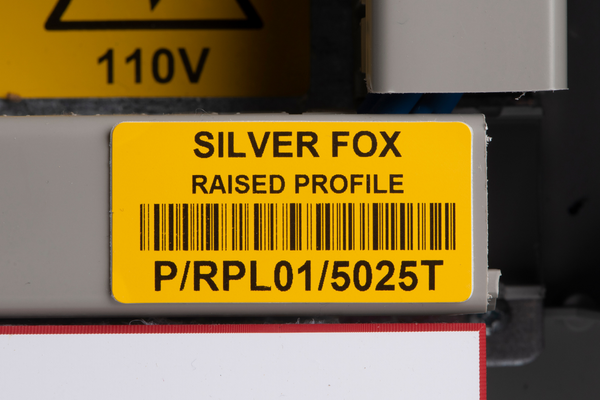
Prolab® Raised Profile Labels are manufactured by Silver Fox® at our facility in Welwyn Garden City, UK. They use a polyester face bonded to a foam carrier, with a strong permanent acrylic adhesive. The raised profile lifts the label face above minor surface imperfections and distributes the adhesive load to maximise bonding on difficult substrates.
Recommended size
40x15mm - best balance of content area and tool fit. Also available in 50x25mm (larger equipment) and 25x12mm (small surfaces).
Colour options
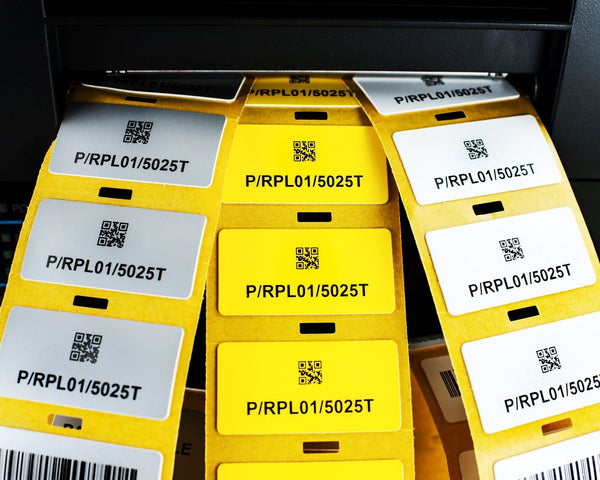
Yellow (recommended for site visibility), White, and Silver. Yellow offers the fastest visual identification on a dark tool body in low-light conditions.
Durability
Operating range -18°C to 70°C. Solvent resistance tested to MIL-STD-202-215. Strong permanent acrylic adhesive for long-term bonding in industrial environments.

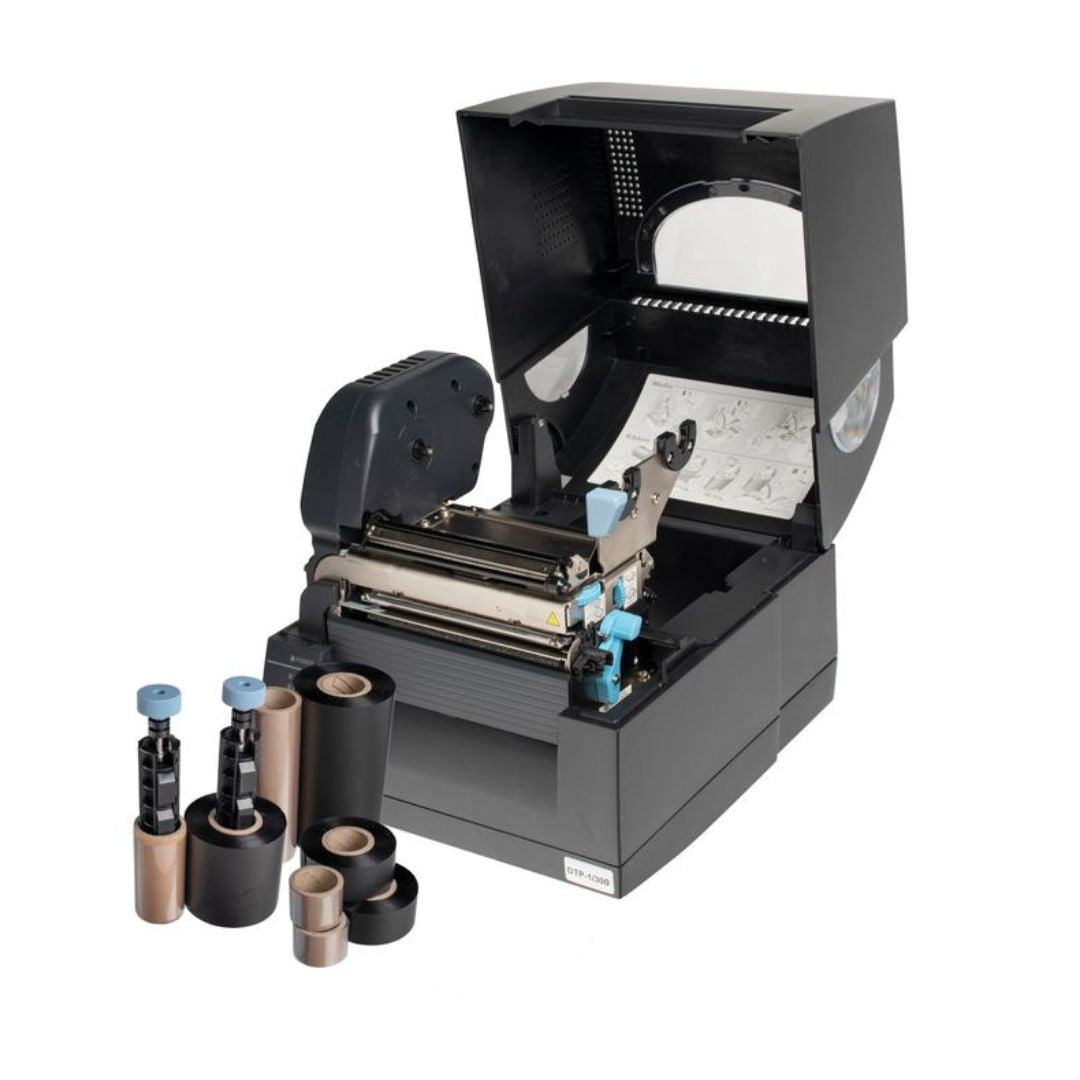
Print content is applied by thermal transfer using a Fox-in-a-Box® printer with a TSR3/300 ribbon. The printed face is permanent, abrasion-resistant, and solvent-resistant. Labels can carry company name, contact number, a sequential reference number, and - at Professional level within Labacus Innovator® software - barcodes, QR codes, and GS1 Data Matrix codes.
4. Application
What to print and where to apply
Company name and direct contact number are the minimum. If you manage a tool register, adding a sequential asset number or QR code turns the label into a direct link between the physical tool and your register - anyone who finds the tool can return it without needing to know who the contractor is.
Placement guidance
Apply to the largest flat area on the tool body - typically the main casing above or below the battery slot on power tools, or the flat side panel on grinders, saws, and multitools. Avoid the grip, the rubber overmould around the chuck, and any surface that flexes during operation. For tools with very limited flat area, the 25x12mm size is available as an alternative to the standard 40x15mm.
For compressors, site radios, and larger portable equipment, the 50x25mm label provides a more visible identification area and can carry additional reference information alongside the contact details.

Surface preparation
Clean the application surface thoroughly with isopropyl alcohol and allow it to dry completely before applying the label. Remove any oil, dust, or mould release residue. Failure to prepare the surface is the single most common cause of early label failure. Apply firm, even pressure across the full label face for at least thirty seconds after positioning.
5. Getting Labelled
Two routes: pre-printed or print in-house
Pre-print service
Silver Fox® can print your labels to your specification and ship them ready to apply. You provide your company name, contact number, any reference numbers, and quantity. Labels arrive in a roll, in order, ready to apply directly to your tools. No equipment investment required. This is the practical route for most contractors and tool hire companies.
Contact [email protected] or call +44 (0) 1707 37 37 27 to discuss specification and request a quote.
In-house printing with Fox-in-a-Box®
If your label content changes regularly - new staff, tools being added, sequential numbers for a growing fleet - in-house printing with Fox-in-a-Box® gives you full control. The Labacus Innovator® software handles sequential numbering, QR code generation, and batch printing across the full Prolab® label range from a single interface. QR code and barcode capability requires the Professional level of Labacus Innovator®. Blank rolls are available directly from silverfox.co.uk.
FAQ
Common questions
Will the label survive being dropped, knocked around, and exposed to site conditions?
Prolab® Raised Profile Labels are tested to MIL-STD-202-215 for solvent resistance and operate from -18°C to 70°C. The polyester face is abrasion-resistant and the thermal print is permanently bonded. Applied correctly to a prepared surface, the label will substantially outlast a paper or standard vinyl sticker on the same surface.
Can I use a Prolab® Raised Profile Label as a PAT testing label?
No. These are identity labels - they carry ownership information such as company name and contact number. PAT testing labels carry test date, pass/fail status, and tester details. The two serve different purposes and can sit on the same tool without conflict.
Can I add a QR code that links to my asset register?
Yes. QR codes are supported at the Professional level of Labacus Innovator® when printing in-house on Fox-in-a-Box®. The QR code can encode any URL. For pre-print orders, Silver Fox® can produce labels with a QR code to your specification - discuss the requirement with the sales team when requesting a quote.
Will the label work on tools that get very hot?
The label's upper operating temperature is 70°C. Most hand and power tool casings stay well within this range in normal use. Do not apply near heat-generating vents or motor housings.
Can I label rubber-handled or over-moulded tools?
Prolab® Raised Profile Labels are not suitable for rubber grips, over-moulded handles, or heavily textured soft surfaces. Most power tools have a suitable flat casing area even when the grip is rubber-coated - identify that area first.
Next Steps
Get your tools identified
Ready to label your fleet?
Whether you need a batch of pre-printed labels ready to apply, or blank rolls for your Fox-in-a-Box® system, Silver Fox® can help you find the right specification for your tools, your site, and your team. Free samples are available on request.
Contact us at [email protected] or call +44 (0) 1707 37 37 27.
References
Monster-Mesh (2025) Tool theft statistics and analysis 2025. Available at: monstermesh.co.uk [Accessed 13 March 2026].
National Federation of Builders (n.d.) Tool theft costs the construction industry. Available at: builders.org.uk [Accessed 13 March 2026].
Trade Direct Insurance / TradeBrain (n.d.) Tool theft on building sites: research findings. Available at: tradedirectinsurance.co.uk [Accessed 13 March 2026].