
Industry Guide
Labelling Military Ground Vehicles and Field Equipment
Defence vehicles and field equipment operate in conditions that destroy standard labels. Here is what defence engineers and contractors need to know about choosing equipment labels that stay legible, stay attached, and meet military specifications.
A military ground vehicle is essentially a mobile harsh environment. Armoured fighting vehicles, logistics trucks, mobile command units, and field generators all carry hundreds of cables, dozens of sub-systems, and critical equipment that must be identifiable throughout a service life measured in decades, not years. When that vehicle deploys to a desert training area, an arctic exercise, or an operational theatre overseas, every label on every cable, panel, and piece of equipment is exposed to conditions that would destroy most commercial labelling within weeks.
Defence contractors, OEMs, and military engineering units face the same fundamental question: how do you label equipment so that identification remains readable and attached after years of fuel splash, vibration, UV exposure, and temperature cycling? This guide covers what needs labelling, why standard materials fail, and which label types and printing systems are built for the job.

1. The labelling challenge
What Needs Labelling on Military Ground Vehicles
A modern military vehicle is far more than an engine on wheels. Protected mobility platforms, communications vehicles, and mobile workshops carry complex electrical and electronic systems that all require clear, durable identification. The labelling requirement spans several categories.
Wiring harnesses and cables. Power distribution, communications, weapons systems, and vehicle management electronics all run through multi-core harnesses routed through confined, high-temperature spaces alongside the engine bay, transmission tunnel, and hull floor. Each cable needs identification that survives contact with diesel, hydraulic fluid, engine coolant, and lubricants. Fox-Flo® LSZH tie-on cable labels are designed for exactly this type of application, providing UV-stable, chemically resistant identification that attaches without adhesive contact to the cable sheath.
Control panels and switchgear. Driver stations, crew compartments, and field-deployable shelters contain panels with switches, circuit breakers, and connection points that must be labelled clearly for operation by personnel who may not be familiar with that specific variant. Engraved traffolyte or acrylic legend plates provide permanent, high-contrast identification that does not fade or degrade. For field-changeable identification, Prolab® Raised Profile Labels printed on the Fox-in-a-Box® system offer a durable alternative to engraving when label content needs to be updated without sending panels back to a workshop.
Tools, test equipment, and ancillaries. Every vehicle carries a tool kit, test equipment, and ancillary items that belong to the platform. On shared exercise areas and in operational bases, these items move between locations. Identity labels linking each item to its parent vehicle or unit prevent loss and simplify accounting. Prolab® Raised Profile Labels with QR codes enable digital asset registers that link each item to a maintenance management system.
Containers, storage systems, and logistics assets. Ammunition bins, spare parts containers, and stowage bins fitted to vehicles need permanent identification that survives rough handling, stacking, and exposure to weather. Engraved stainless steel or anodised aluminium labels provide the durability needed for assets with a 20-year-plus service life.
Typical vehicle labelling requirements
- Cable and harness identification throughout the vehicle electrical system
- Panel legends for switches, breakers, and connection points
- Asset tags for tools, test equipment, and ancillary items
- Nameplate data: NATO Stock Number (NSN), serial number, weight class
- Safety and hazard warnings (high voltage, hot surfaces, lifting points)
- Maintenance and inspection record labels
2. Why standard labels fail
Environmental Challenges in Defence Applications
The UK Ministry of Defence uses DEF STAN 00-35 to define the environmental conditions that defence materiel must withstand in service. These conditions go well beyond what most commercial labelling is designed to handle. Understanding why standard labels fail is the first step to specifying the right solution.
Fuels, oils, and hydraulic fluids. Diesel, JP-8 aviation fuel, hydraulic fluid (OM-15, OX-19), engine oils, and transmission fluids are present throughout a military vehicle. Standard adhesive labels delaminate when oil migrates under the adhesive bond. Print on vinyl labels smears or dissolves on contact with solvents. Labels in engine bays and hull floor areas need both adhesive and face material that resist hydrocarbon exposure.
Vibration and mechanical stress. Military vehicles generate sustained vibration across a broad frequency spectrum, particularly on unprepared surfaces. Labels with rigid adhesive bonds crack and lift at the edges. Tie-on labels such as Fox-Flo® avoid this failure mode entirely because they are mechanically secured rather than bonded to the surface.
Temperature cycling. A vehicle parked in direct sun in a hot climate can see surface temperatures exceeding 70°C. The same vehicle on a winter exercise may sit at -30°C overnight. Repeated cycling between extremes causes adhesive softening in heat (leading to creep and displacement) followed by embrittlement in cold (leading to cracking). Labels specified for defence use must tolerate this cycling without degradation.
Sand, dust, and abrasion. Desert and semi-arid environments introduce fine abrasive particles that wear away print surfaces over time. Direct thermal printing (where the image is formed by heat-sensitive coating on the label surface) is particularly vulnerable. Thermal transfer printing, as used by the Fox-in-a-Box® system, embeds the image into the label material using a resin ribbon, producing print that resists abrasion far more effectively.
UV radiation. Equipment stored outdoors or mounted externally is exposed to sustained UV radiation. Standard polypropylene and PVC labels become brittle and yellow within months. UV-stable materials such as Fox-Flo® are formulated to resist UV degradation, maintaining both print legibility and material integrity over years of outdoor exposure.
3. Materials and products
Choosing Equipment Labels for Defence Environments
No single label format suits every application on a military vehicle. The right approach matches the label type to the specific environment and required service life. Silver Fox® products are independently tested to MIL-STD-202 Method 215 for chemical resistance, providing documented evidence of performance rather than relying on in-house claims alone (Silver Fox, 2025).
Cables & Harnesses
Fox-Flo® LSZH tie-on labels. UV-stable, chemically resistant. Mechanically secured - no adhesive bond to fail. Ideal for engine bays and hull routes.
Equipment & Asset Tags
Prolab® Raised Profile Labels. Foam-carrier polyester with 3M acrylic adhesive. QR code and barcode capability. Tested to MIL-STD-202-215.
Permanent Nameplates
Engraved stainless steel and traffolyte labels. Withstand the full range of defence environments. 20-year-plus service life. Made to order in-house.
Cable and harness identification
For wiring harnesses routed through confined vehicle spaces, tie-on labels are the preferred format. They wrap around the cable bundle and secure with a tie, meaning they do not rely on adhesive contact with the cable sheath. This is critical in environments where oil and fuel contamination make adhesive bonding unreliable. Fox-Flo® tie-on cable labels are manufactured from LSZH (Low Smoke Zero Halogen) material, which produces minimal smoke and no halogen gases in the event of fire. LSZH compliance is increasingly specified for enclosed crew compartments and vehicles with NBC (nuclear, biological, chemical) protection systems.
Asset and equipment labels
Prolab® Raised Profile Labels suit applications where adhesive labels are needed but must resist the hostile vehicle environment. The foam carrier distributes adhesive pressure across the bonding area, compensating for minor surface irregularities on painted metal, composite panels, and equipment housings. Combined with a strong permanent acrylic adhesive, the result is a label that holds where standard self-adhesive labels lift. Using the Professional level of Labacus Innovator® software, these labels can incorporate barcodes, QR codes, and sequential numbering to support asset tracking and inventory management.
Permanent nameplates and legend plates
For identification that must last the full service life of the vehicle, engraved labels are the benchmark. Silver Fox® offers engraving on four industrial-grade substrates: acrylic, traffolyte (phenolic laminate), anodised aluminium, and stainless steel. For military ground vehicles, stainless steel is typically specified for external applications and harsh engine compartment environments, while traffolyte provides high-contrast legend plates for control panels and switchgear. These are manufactured in-house to customer specifications, with no minimum order quantity and short lead times.
4. Printing in the field
A Portable Labelling System for Defence
One of the practical challenges in defence labelling is that label requirements often emerge at unit level, in workshops, on exercise, or during equipment preparation. Waiting for a centralised print facility or an external supplier to produce labels introduces delay that operational tempo does not permit.
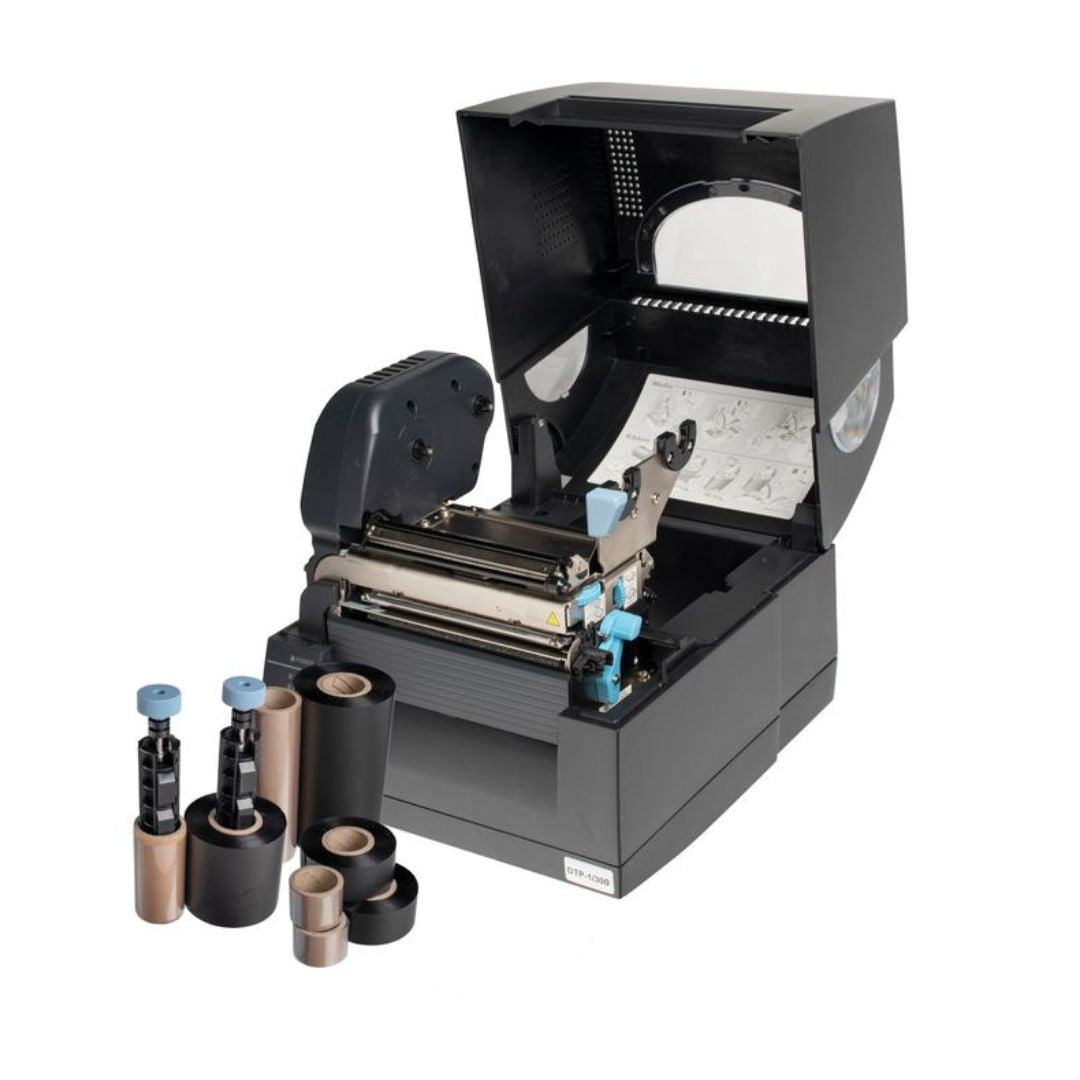
The Fox-in-a-Box® thermal transfer printing system is designed to be self-contained and portable. It combines one printer, one software package (Labacus Innovator®), and one thermal ribbon in a single setup that can produce over 200 types of cable and equipment labels. The system weighs 4.5kg, connects via USB, and prints at 300dpi resolution at speeds of up to 100mm per second.
For defence applications, this means a REME workshop, an OEM integration facility, or a contractor's production line can print cable labels, asset tags, heatshrink markers, wrap-around labels, and equipment identification from one workstation. There is no need for multiple devices, separate software packages, or different consumable types for each label format. Labacus Innovator® supports direct import from spreadsheets and CSV files, enabling engineers to load cable schedules, equipment lists, or asset registers and batch-print entire label runs without re-keying data.
Fox-in-a-Box® for defence: key capabilities
- Over 200 label types from one printer, one software, one ribbon
- Thermal transfer print resists abrasion, chemicals, and UV exposure
- Import wire schedules and equipment lists directly from spreadsheets
- Sequential numbering, barcodes, and QR codes (Professional level)
- 300dpi resolution for legible, scannable output
- Compact 4.5kg unit suitable for workshop or field deployment
Confidentiality is central to how Silver Fox® works with defence customers. We do not disclose contractor, OEM, or government end-user details. What we can confirm is that our labelling solutions are proven across diverse defence applications, and our technical team is available to help specify the right label format, material, and print method for any requirement.
FAQ
Frequently Asked Questions
What labels survive fuel and oil exposure on military vehicles?
Tie-on labels such as Fox-Flo® avoid adhesive contact entirely, so hydrocarbon exposure does not affect attachment. For adhesive labels, Prolab® Raised Profile Labels use a permanent acrylic adhesive that resists oil migration. Both are tested to MIL-STD-202 Method 215 for chemical resistance. For permanent nameplates, engraved stainless steel is inherently resistant to fuels, oils, and solvents.
Do Silver Fox® labels meet MIL-STD specifications?
Yes. Silver Fox® cable labels and equipment labels are independently tested to MIL-STD-202 Method 215, which covers chemical resistance under environmental stress conditions. Testing is conducted by independent test houses, not in-house. Specific test reports are available on request for project specification purposes.
What is DEF STAN 00-35?
DEF STAN 00-35 is the UK Ministry of Defence standard that defines the environmental conditions that defence materiel is expected to encounter in service. It covers climatic categories (temperature, humidity, solar radiation), mechanical environments (vibration, shock), and other factors such as sand, dust, and salt fog. Equipment and its labelling must be specified to withstand the conditions defined in this standard for the intended deployment profile.
Can I print labels in a field workshop?
Yes. The Fox-in-a-Box® thermal printer weighs 4.5kg and requires only a USB connection to a laptop and a standard power supply. It is regularly used in workshop environments to produce labels on demand. The Labacus Innovator® software runs on Microsoft Windows® 8.1, 10, or 11 and requires minimal system resources (1 GHz processor, 1 GB RAM, 200 MB disk space).
Next steps
Get in Touch
Request Free Samples
Not sure which cable marker is right for your application? Silver Fox® offers free samples of Legend™ Heatshrink, Legend™ Non-Shrink, and Fox-Flo® Tie-on labels so you can test them on your actual cables before committing to a specification.
Contact us at [email protected] or call +44 (0) 1707 37 37 27.

References
Ministry of Defence (2024). DEF STAN 00-35: Environmental Handbook for Defence Materiel. UK MOD, Defence Standardization. Available at: gov.uk/guidance/uk-defence-standardization.
Silver Fox® (2025). MIL-STD-202 Method 215 Test Results. Independent testing documentation. Available on request from [email protected].
US Department of Defense (2023). MIL-STD-130: Identification Marking of US Military Property. Defense Logistics Agency.