
Pipe Labelling Guide
BS 1710 Pipe Colour Codes: What Each Colour Means
A quick-reference guide to BS 1710 pipe identification colours, placement rules, and label sizing for UK facilities and industrial sites.
1. The standard
What is BS 1710 and who needs to comply?
BS 1710:2014, published by BSI (British Standards Institution), is the UK standard for the identification of pipelines and services. It covers pipes, ducts, and conduits in both above-ground and below-ground installations, and it applies across commercial buildings, industrial facilities, hospitals, schools, and infrastructure sites.
The standard exists to support compliance with the Health and Safety (Safety Signs and Signals) Regulations 1996, which require employers to provide appropriate safety signs, including pipe identification, wherever there is a risk to health and safety that cannot be avoided or controlled by other means. In practice, BS 1710 is widely adopted by facilities managers, building services engineers, mechanical contractors, and anyone responsible for pipework identification in the UK.
BS 1710 specifies three things: the colour coding system used to identify pipe contents, the information that must appear on pipe markers (including flow direction and content descriptions), and where markers must be positioned along a pipe run. For a broader look at how BS 1710 sits alongside international frameworks such as ISO 20560, see our guide to labelling pipes according to ISO standards.
2. Colour reference
The eight basic identification colours
BS 1710:2014 defines eight basic identification colours (BICs), each representing a category of pipe contents. The colours are specified using BS 4800:2011 colour references to ensure consistency across manufacturers and sites. The basic identification colour may be applied over the full length of the pipe or as a band at specified marker locations. The table below summarises the basic identification colours as set out in BS 1710:2014, with colour references in accordance with BS 4800:2011. The green (water) colour code 12 D 45 is confirmed by the Water Regulations Advisory Scheme (WRAS) in its pipe identification guidance, published with authorised extracts from BS 1710:2014.
| Colour | BS 4800 Ref | Pipe Contents | Text |
|---|---|---|---|
| Green | 12 D 45 | Water (potable, process, cooling, fire-fighting, boiler feed) | White |
| Brown | 06 C 39 | Oils, combustible fluids (diesel, lubricating oil, hydraulic fluid) | White |
| Silver grey | 10 A 03 | Other liquids | Black |
| Grey | 10 A 05 | Steam | White |
| Yellow ochre | 08 C 35 | Gases (including natural gas, LPG, and compressed gases) | Black |
| Violet | 22 C 37 | Acids and alkalis | White |
| Light blue | 20 E 51 | Air (compressed air, ventilation, vacuum) | Black |
| Black | 00 E 53 | Drainage, electrical services, other services | White |
Pipe content names, abbreviations, chemical symbols, or numbers must be printed in either black or white, whichever provides better contrast against the identification colour. Where factors such as pressure, temperature, or concentration are important for safety or operation, these must also be included in the text legend (BS 1710:2014).
Important: colour accuracy and sourcing
- The hex values shown above are approximate screen representations only. For specification and procurement purposes, always reference the BS 4800:2011 colour number directly.
- The BS 4800 reference numbers in this table are drawn from published industry guidance based on BS 1710:2014. Before specifying pipe labels for a project, verify the current colour references against the edition of BS 4800 in force at the time of specification.
- BS 1710 also permits user-defined custom colours where additional detail is needed. These are applied as bands between the basic identification colour bands.
3. Additional banding
Safety colours and code colour bands
Beyond the basic identification colours, BS 1710 uses a secondary banding system to communicate additional safety information and to distinguish between services within the same content category. These bands are applied between the basic identification colour bands on the pipe marker.
Safety colours
Safety colours are specified for pipes where the contents present a particular hazard or serve a specific safety function. The two primary safety colours are red, used for fire-fighting services (sprinkler mains, hydrant supplies, hose reels), and yellow, used to indicate dangerous contents or hazardous conditions. These correspond to the safety colour conventions set out in the Health and Safety (Safety Signs and Signals) Regulations 1996.
Code colours for building and medical services
BS 1710 includes specific code colour banding for medical gas pipeline systems (MGPS), general building services, and refrigeration systems. In hospital environments, for example, colour bands distinguish between medical oxygen, nitrous oxide, medical air, and surgical air supplies. In building services, code colours differentiate between types of heating, chilled water, and domestic hot water circuits.
For a complete overview of how these banding systems integrate with the broader ISO framework, see our guide to BS 1710 pipe marking.
4. Placement and sizing
Where to place pipe markers and what size to use
BS 1710 requires pipe identification markers at specific locations along every pipe run. Markers must be positioned at both sides of every valve, at wall and floor penetrations, at direction changes, at branch and tee junctions, and at regular intervals along straight pipe runs. The standard also requires that concealed services (for example, pipes running between floor joists) are marked at intervals of no more than 500mm. A person standing at any point along the pipeline should be able to see at least one identification marker.
Flow direction
The direction of fluid flow must be indicated by an arrow positioned near the basic identification colour. The arrow should be either white or black, whichever provides the best contrast. Where a label with the identification colour is being used rather than a painted band, the flow direction can be indicated by the pointed end of the label itself.

Marker sizing by pipe diameter
BS 1710:2014 specifies that the minimum band width of basic identification and code or safety colours depends on the outside diameter of the pipe, including any lagging or insulation (Water Regulations Advisory Scheme, 2021). The following table shows commonly cited sizing requirements based on the standard. Always verify specific minimum widths against the current edition of BS 1710 when specifying for a project.
| Pipe Outside Diameter | Minimum Marker Width |
|---|---|
| Up to 50mm | 150mm |
| 51mm to 150mm | 200mm |
| 151mm to 250mm | 300mm |
| Over 250mm | Sized to suit, minimum 600mm |
When code or safety colour bands are included in the marker, the basic identification colour appears in equal-width bands on either side of the code or safety colour band. The total marker width must still meet the minimums specified above. Always include the thickness of any lagging or insulation when calculating the pipe diameter for sizing purposes.
5. Pipe label solutions
Choosing the right pipe identification tape
Getting the colour coding right is only half the job. The label itself needs to stay legible for the life of the installation, which could mean years of exposure to UV, moisture, temperature cycling, chemicals, or physical abrasion depending on where the pipe runs.
External and harsh environments
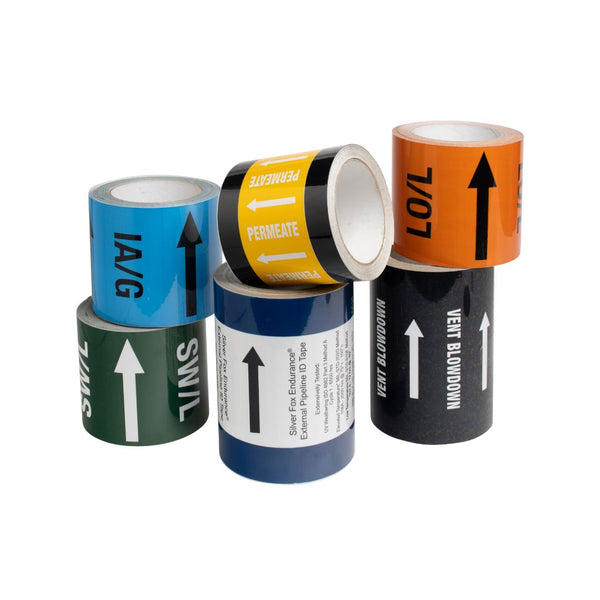
Endurance® External Grade Pipe ID Tape is a 50-micron self-adhesive polyester tape that has been independently tested for 6,500 hours of accelerated UV ageing, along with salt mist spray testing in accordance with the Lloyds Register Type Approval System, H2S exposure, and high/low temperature cycling. It is typically specified for oil and gas, offshore, and other demanding environments. Available in 50mm, 100mm, and 150mm widths. Minimum order quantities apply.
Internal and commercial use
Endurance® Internal Grade Pipe ID Tape is a self-adhesive PVC tape designed for general commercial applications where UV exposure is not a primary concern, such as plant rooms, risers, and service corridors. Available in 50mm, 100mm, and 150mm widths. Minimum order quantities apply.
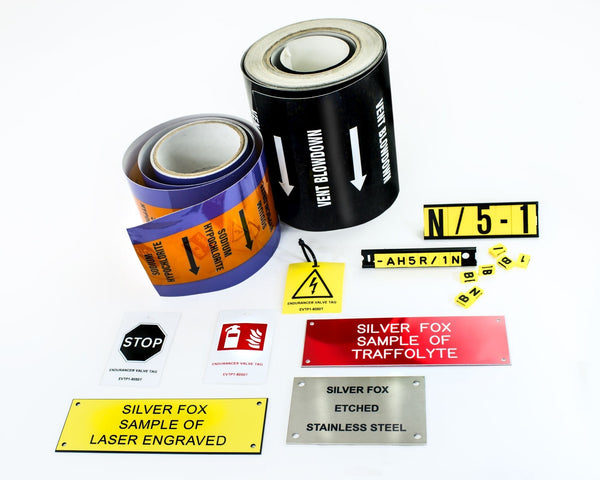
Both Endurance® Pipe ID Tape products are produced bespoke at the Silver Fox® factory in Hertfordshire. Colours and markings are matched to BS 1710 (BS 4800 colour references), ISO 14726, and ASME/ANSI A13.1 standards. Custom RAL or Pantone colour matching is also available, along with service messages, flow direction arrows, and supplementary text, all incorporated during production. Certificates of conformity are available on request for the External Grade product.
Valve identification
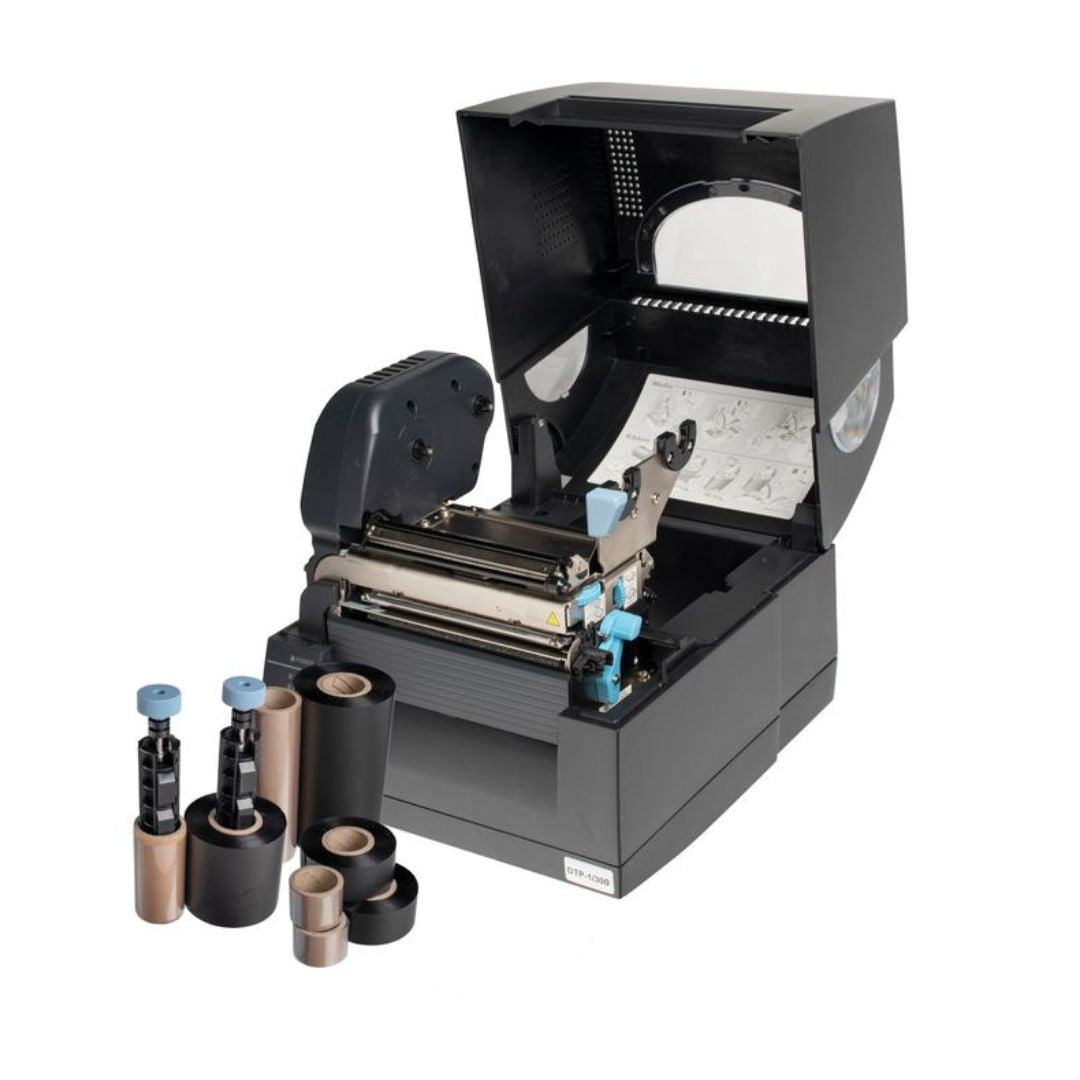
Pipe identification extends to valves, which require their own tagging for maintenance and operational purposes. Endurance® PVC Valve Tags are available in two sizes (60x50mm and 80x50mm) and can be printed on-site using the Fox-in-a-Box® thermal printer. This allows engineers to produce valve identification as needed during installation and commissioning, using the same printer, ribbon, and Labacus Innovator® software used across the Silver Fox® thermal label range. For more on engraved valve tag options, see our guide to traffolyte labels.
For a deeper look at label durability across different environmental threats, see our guide to durable labels for harsh environments.
6. FAQ
Common questions about BS 1710 pipe colour codes
What is the symbol for pipe identification under BS 1710?
BS 1710 does not use a single universal symbol for pipes. Instead, it uses a colour-coded banding system combined with text legends, chemical symbols, abbreviations, and flow direction arrows. The basic identification colour itself is the primary visual indicator, applied either as a full-length coating or as bands at specified marker positions along the pipe run.
Is BS 1710 a legal requirement?
BS 1710 is a standard published by BSI, not a statute. However, the Health and Safety (Safety Signs and Signals) Regulations 1996 require employers to provide pipe identification where there is a risk to health and safety. BS 1710 is widely recognised as the accepted method of meeting that obligation in the UK, and compliance with the standard is commonly specified in building contracts, facility management agreements, and industry codes of practice.
What is the difference between pipe identification labels and pipe identification tape?
In practice, the terms are often used interchangeably. Pipe identification tape typically refers to a continuous roll of self-adhesive material that is wrapped around or applied along the pipe. Pipe identification labels, pipework labels, and pipe marking labels all describe the same product category. The key requirement under BS 1710 is that whatever format is used carries the correct identification colour, content description, and flow direction.
Can I print my own BS 1710 pipe labels?
BS 1710 pipe identification tape that carries the full BS 4800 colour-coded backgrounds is produced bespoke to specification. Silver Fox® manufactures Endurance® Pipe ID Tape at its Hertfordshire facility, matched to BS 1710 colour requirements. For valve tags, the Fox-in-a-Box® thermal printer allows on-site printing. However, on-site thermal printing produces single-colour output, so BS 1710-compliant pipe tape with full colour coding must be factory-produced.
How often should pipe labels be replaced?
BS 1710 does not specify a replacement interval. Labels should be replaced when they are no longer legible, when the colour has faded to the point where identification is unclear, or when the contents of the pipe change. Choosing a pipe identification tape with proven UV and chemical resistance reduces the frequency of replacement. Endurance® External Grade Pipe ID Tape has been independently tested for 6,500 hours of accelerated UV ageing, which is designed to support extended service life in outdoor and exposed environments.
Next steps
Get the right pipe labels for your project
Bespoke BS 1710 pipe identification tape
Silver Fox® manufactures Endurance® Pipe ID Tape to your exact colour, width, and content specifications at our Hertfordshire factory. Whether you need External Grade polyester for offshore pipework or Internal Grade PVC for commercial plant rooms, we can match BS 1710, ISO 14726, or custom RAL and Pantone colours with service messages and flow arrows incorporated during production.
Contact us at [email protected] or call +44 (0)1707 37 37 27 to discuss your requirements.
References
BSI (2014). BS 1710:2014 Specification for identification of pipelines and services. London: British Standards Institution. Available at: knowledge.bsigroup.com.
BSI (2011). BS 4800:2011 Schedule of paint colours for building and decorating purposes. London: British Standards Institution.
Water Regulations Advisory Scheme (2021). Pipe Identification: BS 1710. Information Leaflet, Version 1.1. Available at: waterregsuk.co.uk. Contains authorised extracts from BS 1710:2014 reproduced with permission from BSI Standards Limited.
Health and Safety Executive (1996). The Health and Safety (Safety Signs and Signals) Regulations 1996. Available at: www.hse.gov.uk.