
Regulatory Guide
CAA Drone Labels: The Complete Operator's Guide
Every commercial drone over 250g must carry a physical Operator ID label. Here is exactly what the law requires, what it does not require, and how to label a single drone or an entire fleet correctly the first time.
If you operate a commercial drone in the UK, your aircraft must carry your CAA Operator ID before it leaves the ground. That is not guidance - it is a legal requirement under the Air Navigation Order 2016, and failure to comply can result in your registration being revoked and your operations grounded.
Yet for all the official documentation, one simple question goes unanswered: what kind of label do you actually need? The legislation is clear on what must be displayed and where, but it says nothing specific about materials, adhesives, or formats. This guide explains what the regulations require, what the CAA has confirmed in writing, and how to choose a label that will last the working life of the aircraft - whether you operate one drone or a fleet of fifty.
1. The Basics
What Is a Drone Operator ID Label?
When you register as a drone operator with the Civil Aviation Authority, you are issued a unique Operator ID - a reference in the format OPR-XXXXX. This number must be physically displayed on every drone you operate. That physical display is the Operator ID label.
This is distinct from drone registration numbers used elsewhere. It is also entirely separate from the CLASS label (the CE marking C0 through C6 that drone manufacturers apply at the factory). The CLASS label identifies the drone model and its built-in safety features. The Operator ID label identifies who is flying it. The manufacturer fits the CLASS label; the operator fits the Operator ID label. Silver Fox® labels address the Operator ID requirement - never the CLASS label, which is the manufacturer's responsibility.
Important: Two different labels, two different responsibilities
CLASS labels (CE marks, C0-C6) are fitted by the drone manufacturer and are not something operators apply. Do not confuse these with the Operator ID label. If you are an operator, your responsibility is the Operator ID label only.
The Operator ID label requirement applies to all drones over 250g flown in the UK. It also applies to drones with a camera, regardless of weight, in many operating categories. If you are flying commercially under the CAA's operational authorisation framework, the label is mandatory without exception.
2. UK Regulations
What the CAA Actually Requires
The Air Navigation Order 2016, Article 94A, sets out the physical requirements for drone Operator ID labels in the UK. The CAA Drone Code translates these requirements into practical operator guidance. The core requirements are straightforward:

The Civil Aviation Authority is the UK's aviation regulator. Drone operator registration and Operator ID requirements are set out in the CAA Drone Code.
- Content: Your CAA Operator ID, displayed in block capitals.
- Size: Block capitals taller than 3mm.
- Position: On the main body of the aircraft - not on a battery, accessory, or removable component.
- Condition: Legible, secure, and protected from damage.
On the question of materials and adhesives, the Air Navigation Order and CAA Drone Code are silent. There is no prescribed material, no approved adhesive list, and no specified label format. The regulation defines the outcome - legible, secure, and protected - and leaves the method to the operator.
This is important because it clarifies the decision for commercial operators. The standard is functional, not prescriptive. A label must stay on, stay readable, and stay intact under the conditions the aircraft operates in. For professional operations - outdoor flying, variable weather, repeated handling, landing on rough surfaces - that standard points clearly towards industrial-grade labelling, not office stationery.
CAA Compliance Checklist
- Operator ID displayed in block capitals
- Characters taller than 3mm
- Affixed to the main body of the aircraft
- Label is legible and protected
- Label is secure - will not detach in normal operation
- Every drone in your fleet labelled individually
3. Label Specification
What Makes a Drone Label Fit for Purpose?
The regulations define what a label must achieve, not what it must be made of. That puts the burden on the operator to choose a label that will perform in the actual conditions the aircraft operates in. For commercial drone operations, those conditions are demanding.
UV Exposure
Outdoor operations expose labels to continuous UV radiation. Standard inkjet or laser-printed labels on paper or basic polypropylene will fade and become illegible within months.
Adhesion
Drone airframe surfaces are often curved, textured, or painted with specialist coatings. Standard office adhesives are not designed for these substrates. A label that peels is a non-compliant label.
Physical Handling
Commercial drones are transported, maintained, and repaired regularly. Labels must withstand handling, storage in cases, and proximity to tools - not just flight conditions.
Prolab® labels from Silver Fox® are designed to meet exactly these demands. The polyester face material is UV-stable, resistant to moisture, and dimensionally stable across a wide temperature range. The 3M permanent acrylic adhesive bonds reliably to the smooth moulded surfaces typical of drone airframes, and a laminate layer over the print bonds the text permanently - it cannot be removed without destroying the label. At the CAA-minimum 3mm character height, a Prolab® label sits well within the compliant range and remains clearly legible at typical inspection distances.

For battery labelling - which sits outside the CAA airframe requirement but is strongly recommended practice for any commercial operation - Prolab® Laser Fibre Optic Flag labels provide an effective tie-on format (known in the industry as PTAG) that works on the irregular shapes of drone battery packs and landing gear where flat adhesive labels cannot bond reliably.
4. Fleet Operations
Fleet Labelling: The Numbers Add Up Quickly
For individual hobby pilots who have entered the commercial space, one or two drone labels is a straightforward task. For survey companies, inspection contractors, utilities operators, and media production teams, the scale changes the problem entirely.

At that scale, hand-writing labels or ordering custom stickers one batch at a time creates errors, delays, and inconsistency. A label printed in the wrong size or with a transposed character leaves the operator non-compliant on that aircraft until corrected.
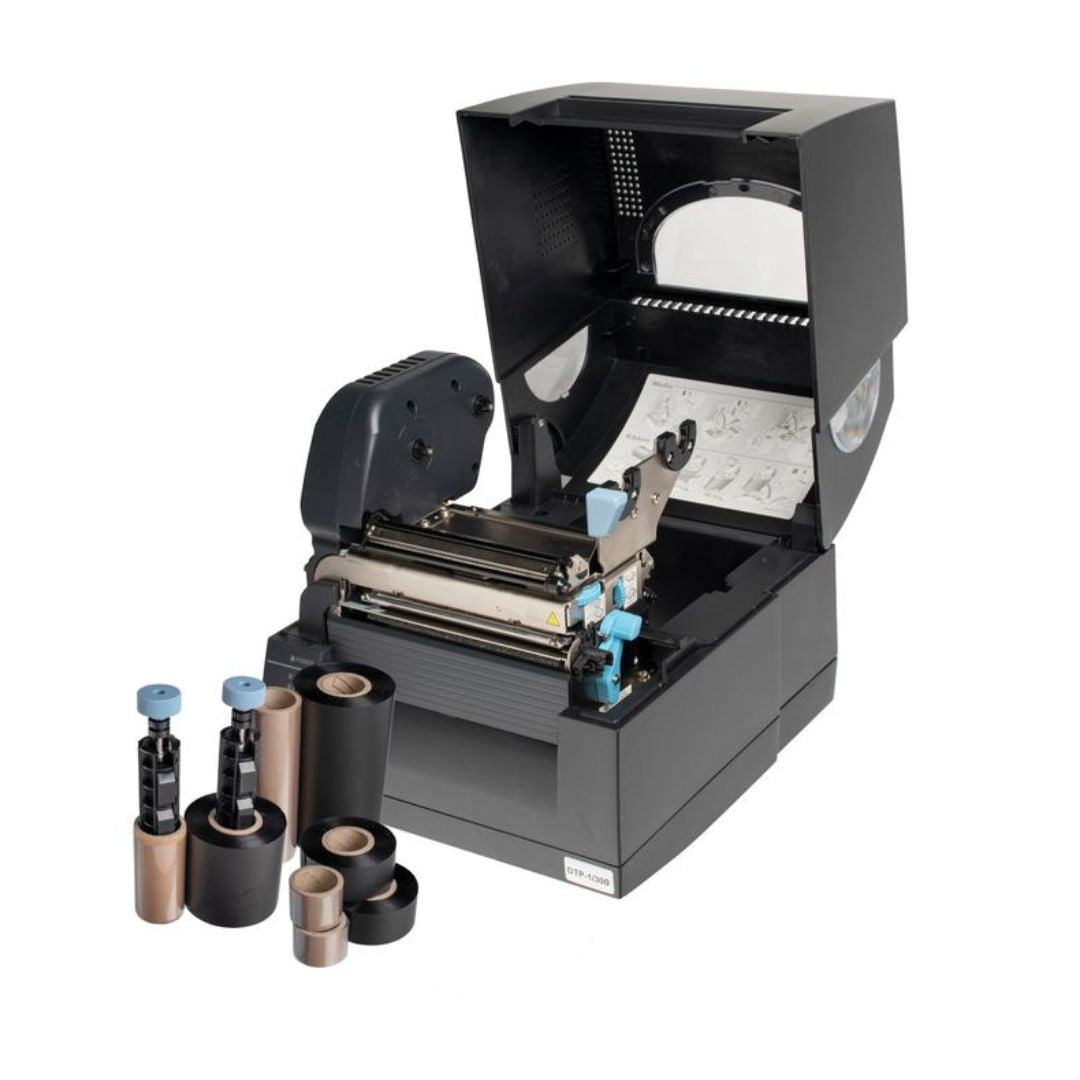
The professional answer is a batch-printing workflow. The Fox-in-a-Box® thermal transfer printer, paired with Labacus Innovator® software, gives fleet operators the ability to print a full batch of serialised, QR-coded drone labels in a single run. Each label carries the Operator ID, a unique serial number for internal asset tracking, and a QR code that links to the drone's maintenance record. The entire label set for a 10-drone fleet can be produced in minutes, with the same character height and print quality on every label.
Setting Up a Fleet Label Workflow
-
1
Register and obtain your Operator ID
Complete operator registration with the CAA at dronesafe.uk. Your OPR-XXXXX reference is issued immediately on registration. Keep it to hand - you will need it for the next step.
-
2
Build your label template in Labacus Innovator®
Set your Operator ID as fixed text. Add a sequential serial number field for individual drone identification. Add a QR code field linked to your asset register. Confirm character height meets 3mm minimum.
-
3
Print your full batch on Prolab® stock
Fox-in-a-Box® prints the complete label set in one run. Thermal transfer printing with the correct ribbon produces print that is resistant to UV, moisture, and abrasion - the three main failure modes for airframe labels.
-
4
Affix and record
Apply the airframe label to the main body of each aircraft. Note the serial number against each drone in your asset register. Inspect each label after the first flight to confirm adhesion on that airframe's specific surface finish. Battery and controller labelling is not a legal requirement but is recommended practice for larger fleets - Prolab® PTAG flag labels work well on battery packs where flat adhesive labels cannot bond reliably.
5. FAQ
Common Questions
Do I need a label on every drone in my fleet, or just one per operator?
Every drone in your fleet must carry its own physical Operator ID label. Registration is per operator, but the labelling requirement is per aircraft. If you operate ten drones, all ten must be individually labelled - the same Operator ID appears on each, but each airframe must carry it independently.
Can I write the Operator ID by hand instead of printing it?
The CAA requires the ID to be in block capitals and to remain legible, secure, and protected. A hand-written label is not prohibited by the letter of the regulation, but it is difficult to guarantee consistent character height, legibility in all conditions, and long-term durability. For any professional operation, a printed label is the only reliable approach.
Does the label need to be on the outside of the drone?
The CAA requires the label on the main body of the aircraft. Affixing it to a visible, flat surface on the main body is the safest approach. Avoid placement on batteries, removable accessories, or under hatches that require tools to open.
What is the difference between a drone operator ID and a CAA drone code?
The CAA Drone Code is the set of safety rules all drone pilots must follow - covering where you can fly, how close to people, and how high. The Operator ID is the unique reference number issued when you complete operator registration. Both sit within the same regulatory framework, but the Drone Code is the rulebook and the Operator ID is your individual identifier within it.
Do my batteries need to be labelled?
The CAA's airframe label requirement does not extend to batteries specifically. However, battery identification is strongly recommended practice for any commercial operation. Mixed battery packs across a fleet create maintenance and safety risks. Prolab® PTAG flag labels provide a practical tie-on solution for battery packs where the curved or irregular surface prevents flat adhesive labels from bonding securely.
How small can the label be?
The minimum is set by the character height requirement: block capitals taller than 3mm. Your Operator ID in the format OPR-XXXXX at 3mm character height will fit comfortably on a label of 40mm by 15mm, which also leaves room for a serial number and QR code without crowding. Prolab® labels are available in a range of sizes to suit different airframe footprints.
What happens if a label falls off during a flight?
A drone without a legible, affixed Operator ID label is technically non-compliant with the Air Navigation Order 2016 for the duration of that flight. Replace the label before the next operation. This is one reason why adhesive quality matters: a label that bonds reliably to the airframe surface is not an optional upgrade for professional operators - it is part of maintaining compliance at every flight.
Next Steps
Label Your Fleet With Confidence
Get CAA-Compliant Drone Labels
Silver Fox® supplies Prolab® Operator ID labels for commercial drone operators across the UK. Whether you need labels for a single aircraft or a fleet of hundreds, the Fox-in-a-Box® printing system and Labacus Innovator® software give you consistent, serialised, QR-coded labels produced in-house - in one run, every time.
Contact our team to discuss your fleet labelling requirements: [email protected] or call +44 (0) 1707 37 37 27.
References
Civil Aviation Authority (2024). The Drone Code. Available at: www.caa.co.uk/drones.