
Data Centre Labelling
Cable Labels for Immersion-Cooled Data Centres
Single-phase dielectric cooling changes what a cable label must withstand. Here is what engineers need to know - and how Silver Fox® has solved it.
Data centres are under pressure. Hyperscale compute densities are rising, power costs are climbing, and sustainability targets are becoming harder to ignore with air cooling alone. Single-phase immersion cooling addresses all three: processors run submerged in a non-conductive dielectric fluid, transferring heat far more efficiently than forced air. But changing the cooling medium changes the environment for everything inside the tank - including the labels.
For engineers specifying or installing immersion-cooled infrastructure, labelling is not a minor detail. Cables, harnesses, frames and equipment still need clear, durable identification so that the facility can be expanded, maintained and faulted on quickly. The question is whether the labels can keep pace with the environment they are working in.
1. Context
How single-phase immersion cooling works
In a single-phase immersion system, servers and active components are placed directly into a tank filled with a purpose-formulated dielectric fluid. The fluid absorbs heat from the components and carries it to a heat exchanger, from which it can be rejected or, increasingly, recovered and reused. Unlike two-phase systems, the fluid remains in liquid form throughout - it does not boil or evaporate under operating conditions.
The dielectric fluid used matters. Fluids such as Castrol ON are specifically engineered for data centre immersion cooling: they are designed to improve thermal performance, cut energy and water consumption, and support sustainable facility operation. They are also non-conductive, which is what makes direct contact with active electronics possible in the first place.
That non-conductive property has implications for labelling. The fluid is an active chemical environment. Any material placed inside the tank for the long term - including labels, ties and markers - must coexist with it without degrading or causing degradation.


2. The challenge
Why standard labels are not suitable
Most industrial cable labels are designed and tested against environmental conditions common to data centres, industrial facilities and outdoor infrastructure: UV exposure, temperature cycling, moisture, and cleaning agents. Prolonged immersion in dielectric fluid is an entirely different test, and the vast majority of label products have not been evaluated for it.
The risks split into two distinct categories:
Label survival
The label material, print and attachment mechanism must remain intact and legible after continuous contact with the fluid over months or years. Swelling, delamination, print fade or tie degradation all result in identification loss - exactly when reliable identification matters most.
Fluid integrity
Labels must not leach plasticisers, dyes, adhesives or other compounds into the cooling fluid. Contamination can alter the fluid's dielectric and thermal properties, potentially affecting system performance and voiding fluid warranties. This risk is frequently overlooked when specifying labels for immersion systems.
Both risks need to be addressed before a label can be confidently specified for use inside an immersion tank. It is not enough to find a label that looks intact after brief exposure - it must be shown to resist the specific fluid used in the system, over representative timescales.
3. Material requirements
What a fluid-resistant label needs to deliver
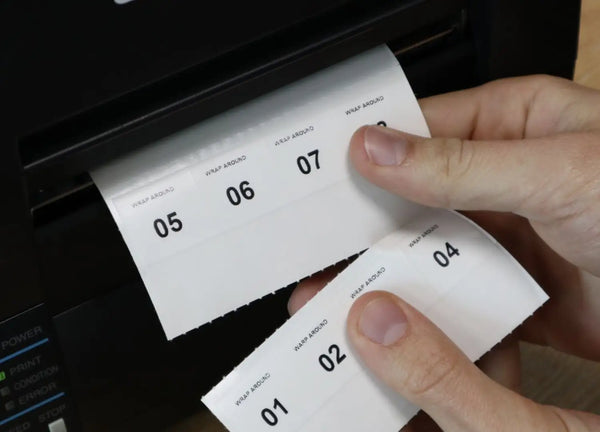
Tie-on labels are the natural choice for immersion environments. They attach to cables and assemblies with a tie rather than an adhesive - which removes one of the most common failure points in fluid-exposed applications. There is no adhesive layer to swell, migrate or separate from the substrate.
Beyond attachment, three properties determine whether a label will perform inside an immersion tank:
- Material stability: The label substrate must not absorb the fluid, swell, become brittle, or lose dimensional integrity over time. Changes in shape or rigidity can make labels difficult to read and can create pressure points on cables they are attached to.
- Print permanence: The printed text must remain clear and legible throughout the service life of the installation. Ink or toner that is soluble in or softened by the fluid will result in identification loss, which creates operational and safety risk during maintenance work.
- Chemical passivity: The label materials must not contribute contaminants to the fluid. This is a two-way test: the fluid must not damage the label, and the label must not damage the fluid.
Meeting all three criteria requires testing against the specific fluid in use, not just generic chemical resistance data. Different dielectric fluids have different compositions, and a label's performance in one fluid does not guarantee performance in another.
4. Silver Fox® solution
Legend™ Tie-On labels: proven against Castrol ON
Silver Fox® developed and tested Legend™ Tie-On labels specifically for use in single-phase immersion systems using Castrol ON dielectric cooling fluid. Both the label and print have been shown to resist the fluid, remaining clear and easy to read for maintenance and fault-finding after immersion. Critically, testing confirmed that the labels do not compromise the properties of the fluid itself.
 Tested and proven resistant to
Castrol ON dielectric cooling fluid
Two variants are available, each supporting a different printing workflow:
Thermal
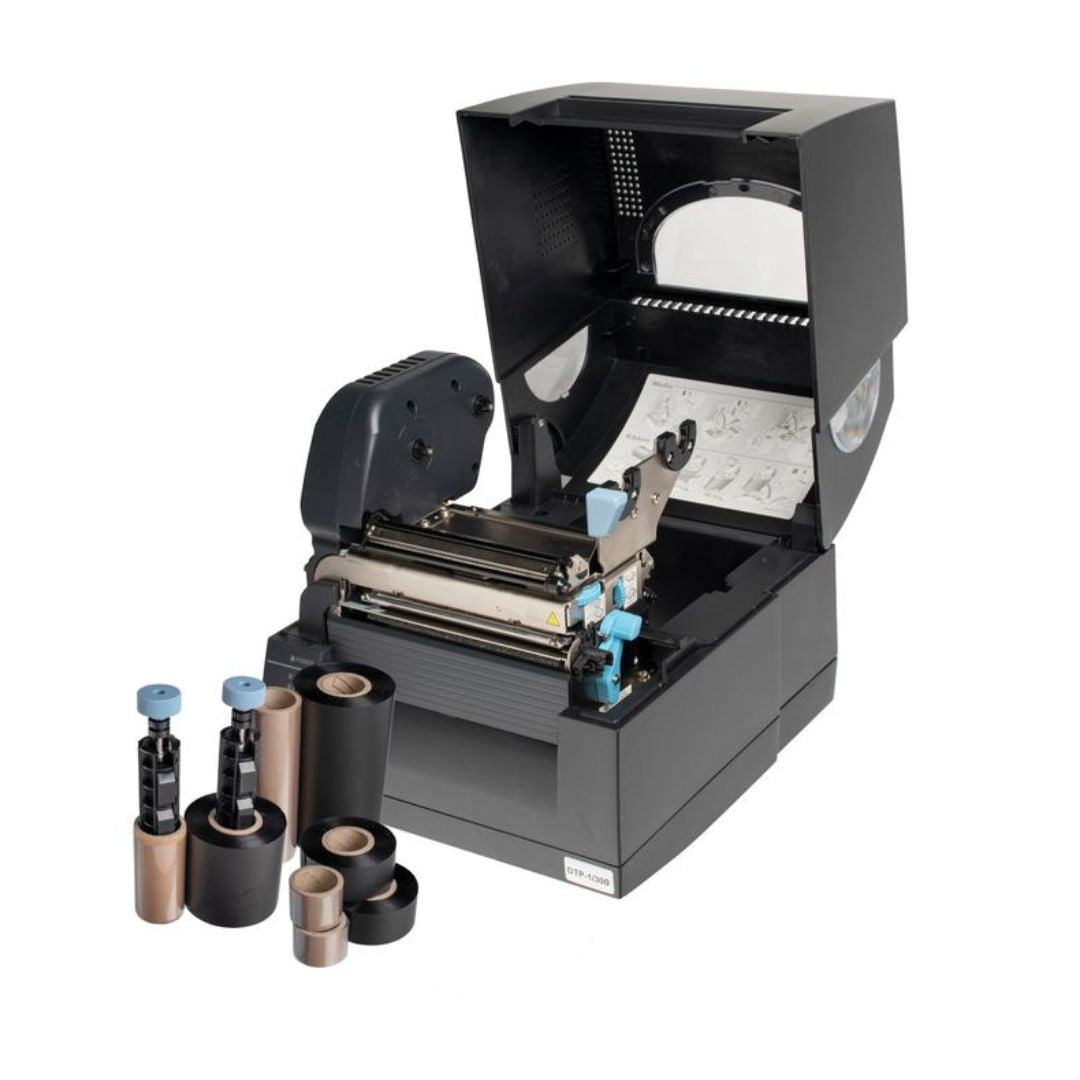
Legend™ Thermal Tie-On labels are printed using the Fox-in-a-Box® thermal transfer printer. They are suited to on-site or in-house printing workflows where speed and consistency are priorities.
Laser
Legend™ Laser Tie-On labels are printable using a standard office laser printer, with no dedicated hardware required. They suit teams that already have laser printing capability on site or in the design office.
Both variants
Both have been shown to be resistant to Castrol ON dielectric cooling fluid. Labels remain legible after immersion. Neither variant compromises the fluid integrity of the cooling system.
For facilities teams and M&E contractors specifying into immersion-cooled environments, this removes a gap that has previously required either improvised solutions or acceptance that labelling inside the tank would degrade over time. It also gives project documentation a verified, repeatable specification rather than a best-effort selection.
Why tie-on labels suit immersion environments
- No adhesive layer to separate, migrate or contaminate the fluid
- Secure attachment to cables and harnesses of varying diameters
- Labels remain repositionable during installation before final tie-down
- Suitable for high-density cable arrangements typical of server infrastructure
- Compatible with both pre-print and on-site print workflows
5. Specification guidance
Integrating fluid-resistant labels into your project
For most data centre projects, immersion-cooled zones represent a subset of the overall installation. The rest of the facility - dry corridors, patch rooms, external cable management, above-rack infrastructure - will use standard cable labels selected for the conditions there. It is only within the tank that fluid-resistant labels are required.
A practical approach is to define the fluid boundary early in the labelling specification: identify every cable and assembly that will be submerged, and ensure those are designated for Legend™ Tie-On labels from the outset. This prevents the common problem of discovering mid-installation that labels intended for dry areas have been installed inside a tank.
Labacus Innovator® software supports the pre-printing of high volumes of Legend™ Tie-On labels from cable schedules and wire lists, which means labels for immersion zones can be produced alongside the rest of the project's labelling in a single printing run - then separated and applied to the appropriate cables before installation. For projects using the Fox-in-a-Box® thermal system, this integration is straightforward and keeps the whole project on one platform.
For further detail on Silver Fox's® dielectric fluid-resistant label range - including product samples and application advice - see the Castrol ON fluid-resistant labels page.
FAQ
Common questions
Can standard cable labels be used in dielectric cooling fluid?
Not reliably. Standard industrial cable labels are designed and tested against common environmental hazards such as UV exposure, moisture, and industrial cleaning agents - not prolonged immersion in dielectric fluid. Most will degrade over time in an immersion environment, losing legibility and potentially leaching compounds into the fluid. Labels intended for use inside an immersion tank should be tested specifically against the fluid in use.
Do Legend™ Tie-On labels affect the dielectric cooling fluid?
Testing has shown that Legend™ Tie-On labels do not compromise the properties of Castrol ON dielectric cooling fluid. This is an important part of the qualification - a label that survives the fluid but contaminates it in the process would still create a problem for the facility. Both the label-survival and fluid-integrity criteria have been addressed.
What is the difference between the Thermal and Laser variants?
The difference is in how they are printed, not in their fluid resistance. Legend™ Thermal Tie-On labels are produced using the Fox-in-a-Box® thermal transfer printer and are suited to on-site and in-house printing workflows. Legend™ Laser Tie-On labels are printed on a standard office laser printer with no specialist hardware required. Both variants have been shown to resist Castrol ON dielectric cooling fluid.
Are fluid-resistant labels needed throughout an immersion-cooled data centre?
Only within the immersion tank itself. Dry areas of the facility - corridors, patch frames, above-rack infrastructure, external cable routes - use standard cable labels appropriate to those environments. The fluid boundary is the key dividing line. Cables that cross from a dry area into the tank should be labelled with fluid-resistant labels at the point of entry and throughout their submerged length.
Next steps
Specify with confidence
Label solutions for immersion-cooled environments
Silver Fox® has addressed the challenge of labelling inside single-phase dielectric cooling systems with Legend™ Tie-On labels proven against Castrol ON fluid. Visit the Castrol ON fluid-resistant labels page for full product details and to request samples.
For project enquiries or advice on specifying labels across a mixed-environment data centre installation, contact us at [email protected] or call +44 (0) 1707 37 37 27.


References
Castrol (2024). Castrol ON Dielectric Cooling Fluid for Data Centres. Available at: castrol.com [Accessed March 2026].
International Energy Agency (2024). Data Centres and Data Transmission Networks. Available at: iea.org [Accessed March 2026].
Park Place Technologies (2024). What Is Immersion Cooling for Data Centers? Available at: parkplacetechnologies.com [Accessed March 2026].
Submer (2024). Single-Phase Immersion Cooling vs Direct-to-Chip Cooling. Available at: submer.com [Accessed March 2026].
Uptime Institute (2024). Global Data Center Survey 2024. Available at: uptimeinstitute.com [Accessed March 2026].