
Cable Marking Guide
Non-Shrink Cable Markers: A Faster Alternative to Ferrules and Heat Shrink
How non-shrink cable markers work, when to use them instead of ferrules or heat shrink, and why the LSZH Fox-Flo® version is built for demanding industrial environments.
Wire marking has traditionally been one of the most time-consuming tasks in electrical and instrumentation projects. Individual ferrules, while effective, require handling each marker separately, often taking nearly two hours to mark just 50 wires. Heat shrink sleeves offer an alternative but demand pre-termination planning and heat gun application, which isn't always practical or permitted on site.
Non-shrink cable markers offer a different approach entirely. Using a unique figure-of-eight twin-loop design, these markers grip cables securely without adhesive or heat application. The result is dramatically faster installation times while maintaining the durability needed for industrial environments.
1. Understanding the basics
What are non-shrink cable markers?
Non-shrink cable markers are a form of cable identification supplied on continuous rolls and designed to grip cables through their physical shape rather than through heat shrinking or adhesive. The markers feature an oval or figure-of-eight profile that wraps around the cable and locks in place, preventing slippage and rotation even under vibration and temperature changes.
Unlike heat shrink sleeves that must be applied before termination and then shrunk with a heat gun, non-shrink markers can be applied to cables at any stage, including after termination. This makes them particularly valuable for retrofit labelling, maintenance work, and situations where heat gun use is restricted or impractical.
How the figure-of-eight grip works
The twin-loop design creates two contact points that grip the cable from opposite directions. When the marker is wrapped around the cable and the loops overlap, they create a secure mechanical grip. This design works across a range of cable diameters within each size, reducing the number of different sizes needed in stock.
Continuous Roll Format
Markers are supplied on rolls and cut to length as needed, reducing waste compared to pre-cut solutions and allowing variable length identification.
No Tools Required
Application requires only scissors to cut the marker to length. No heat guns, cable ties, or specialist tools needed on site.
Post-Termination Application
Can be fitted to cables that are already terminated and installed, unlike heat shrink which must be applied before connectors.
Diameter Flexibility
Each size covers a range of cable diameters, for example 2-4mm or 4-6mm, reducing stock requirements on site.
2. The time saving case
Non-shrink markers vs ferrules and heat shrink
The primary advantage of non-shrink cable markers is speed. In controlled time trials, marking 50 wires with individual ferrules took approximately 1 hour 58 minutes. The same task using non-shrink markers printed on a thermal printer took just 4 minutes 38 seconds, representing a time saving of more than 25×.
When each approach makes sense
Non-shrink markers excel in scenarios where speed matters, where cables are already terminated, or where heat gun use is restricted. They're particularly valuable in panel building, control and instrumentation work, and retrofit or maintenance labelling.
Heat shrink remains the better choice when you need an extremely tight, permanent bond to the cable, when the marker must become essentially part of the cable, or when you're working pre-termination and can plan the heat shrink application into your workflow.
Traditional ferrules may still be preferred for very small wire gauges or where specific client specifications mandate their use. However, for the majority of control and instrumentation cable marking, non-shrink markers offer a compelling combination of speed, durability, and ease of application.
3. Material selection
PVC vs LSZH non-shrink markers
Non-shrink cable markers are available in two main material types, each suited to different applications and environments. Understanding these differences helps ensure compliance with project specifications and optimal long-term performance.
PVC non-shrink markers
Standard PVC non-shrink markers like the Legend™ Non-Shrink Cable Marker Rolls offer excellent durability for general commercial and industrial applications. They're cost-effective and perform well in typical indoor environments such as data centres, commercial buildings, and industrial facilities where Low Smoke Zero Halogen (LSZH) materials aren't mandated.
PVC markers have been tested for UV weathering (4,000 hours for white, 1,000 hours for yellow), elevated temperature exposure up to 85°C, low temperature operation to -40°C, and chemical resistance including H2S sour gas exposure.
LSZH non-shrink markers
For environments where fire safety is paramount, Fox-Flo® UV Stable LSZH Non-Shrink Cable Markers provide the same speed and ease of application with enhanced material properties. Made from Low Smoke Zero Halogen material, they emit minimal smoke and no toxic halogen gases when exposed to fire.
Fox-Flo® LSZH certifications and testing
- EN 45545-2 R22 rail fire safety compliance
- UL 94 V0 flame retardancy rating
- UL 2043 plenum rating for air-handling spaces
- IMO FTPC Part 2 and Part 5 for marine applications
- 8,000 hours accelerated UV testing (12-15 years equivalent)
- Chemical resistance including oils, acids, and solvents
The LSZH version is essential for mass transit and rail projects, marine and offshore installations, data centres with air-handling plenums, tunnels and underground infrastructure, and any environment where smoke and toxic fume reduction is critical for evacuation safety.
4. Application process
How to label cables with non-shrink markers
The application process for non-shrink cable markers is straightforward and requires minimal training. Here's the typical workflow from design to installation.
-
1
Design your cable identification
Using Labacus Innovator® software, create your cable identification scheme. You can import data directly from Excel spreadsheets, generate sequential numbering, and add barcodes or QR codes if using the Professional software level.
-
2
Print with Fox-in-a-Box®
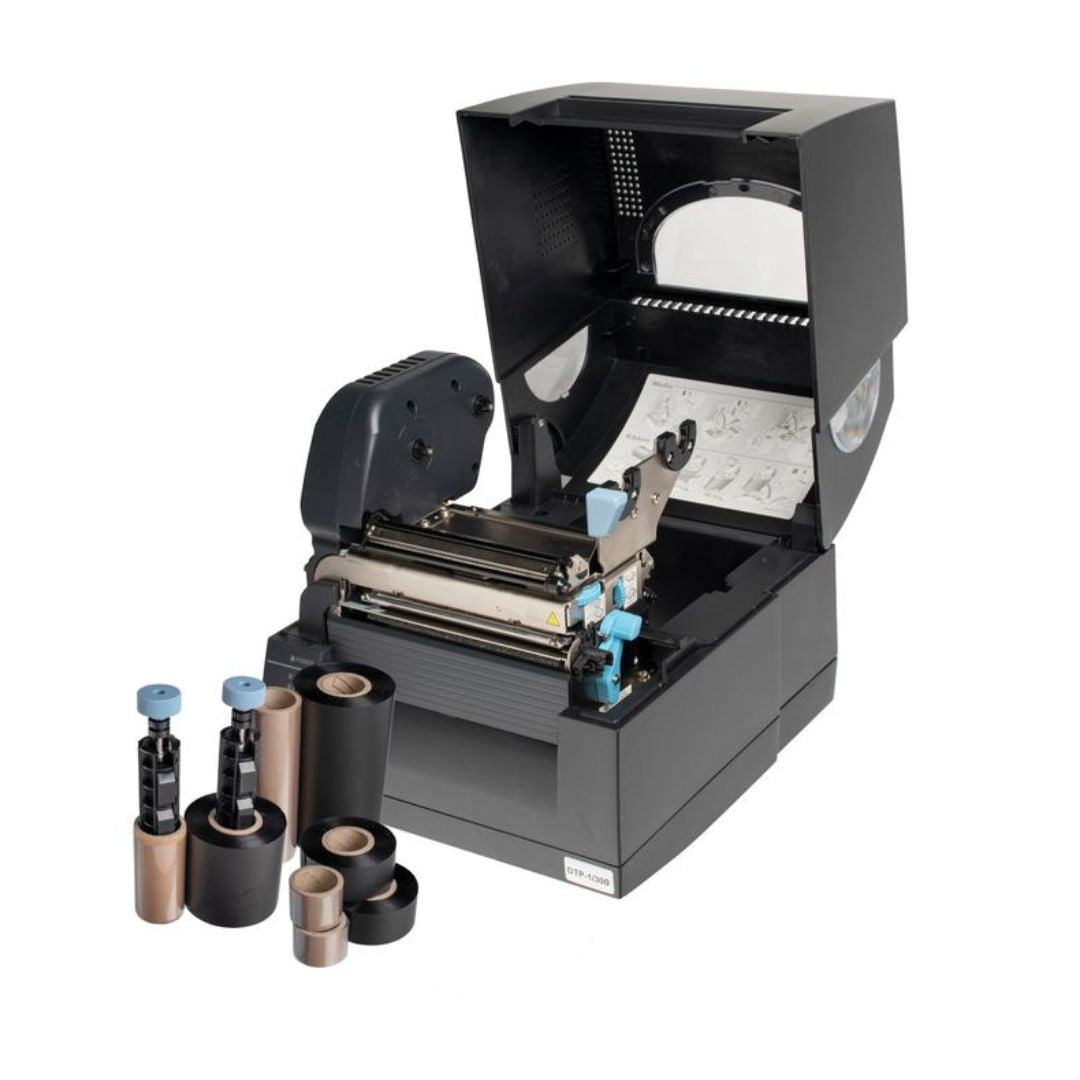
Load the non-shrink marker roll into the Fox-in-a-Box® printer with the LGS3 guidance system. The Advanced and Professional software levels enable cross-ferruling, printing both ends of each cable simultaneously on two rolls.
-
3
Cut to length
Cut each marker to the required length. The continuous roll format means you control the marker length, ensuring the twin loops fully overlap for secure grip on your specific cable diameter.
-
4
Apply to cable
Wrap the marker around the cable in a figure-of-eight pattern so the twin loops overlap and grip. No heat, no cable ties, no adhesive needed. The marker is immediately secure and ready for service.
For guidance on the broader topic of labelling cables that have already been terminated, see our detailed guide on labelling terminated wires.
5. Durability testing
Performance in harsh environments
Non-shrink cable markers, particularly the Fox-Flo® LSZH version, have been extensively tested for long-term performance in demanding industrial conditions. This testing validates their suitability for outdoor, chemical, and temperature-extreme applications.
UV Weathering
8,000 hours accelerated UV exposure, equivalent to 12-15 years in Northern European outdoor conditions.
Temperature Range
Tested from -40°C to 100°C, covering extreme cold installation and continuous elevated temperature operation.
Salt Mist
8,000 hours cyclic salt mist testing for offshore and marine environment suitability.
Chemical resistance
Fox-Flo® LSZH non-shrink markers have been tested against a range of chemicals commonly encountered in industrial environments. The print and substrate show no effect after exposure to water, IPA, SAE30 oil, 10% HCl, and 10% NaOH. Some degradation occurs with more aggressive solvents like MEK and petrol, while complete removal occurs with toluene, jet fuel, and DOT4 brake fluid. Always verify chemical compatibility against your specific project requirements.
This level of testing provides confidence for deployment across sectors including power and renewables, oil and gas installations, petrochemical facilities, and transportation infrastructure where long-term outdoor durability is essential.
6. Typical applications
Where non-shrink markers are used
The combination of speed, no-heat application, and LSZH material options makes non-shrink cable markers suitable for a wide range of industrial sectors.
Control and instrumentation
Panel builders and instrumentation engineers benefit most directly from the speed advantage. The ability to print both cable ends simultaneously using cross-ferruling, combined with tool-free application, transforms what was traditionally one of the slowest tasks in panel assembly.
Oil, gas, and petrochemical
The absence of heat gun requirements is particularly valuable in hazardous area work where hot work permits add complexity and delay. LSZH material options provide the fire safety compliance often required in these environments, while chemical resistance testing validates performance against common industrial fluids.
Rail and mass transit
EN 45545-2 R22 compliance on the Fox-Flo® LSZH version addresses the strict fire safety requirements for rolling stock and rail infrastructure. The speed of application also helps contractors meet tight commissioning timescales on rail projects.
Data centres and telecoms
High cable density environments benefit from both the speed of marking and the consistent, professional appearance. For environments with fire safety requirements in air-handling plenums, the UL 2043 plenum rating on Fox-Flo® provides compliance confidence.
Non-shrink markers are ideal when
- Cables are already terminated
- Heat gun use is restricted or impractical
- Speed of installation is critical
- LSZH materials are required for fire safety
- Outdoor UV exposure is expected
- Chemical resistance is needed
7. Common questions
Frequently asked questions
Will the marker slip or rotate on the cable?
No. The figure-of-eight twin-loop design creates a mechanical grip that holds securely under vibration and temperature cycling. The markers have been tested to maintain position across their rated temperature range and in environmental stress conditions.
How do I choose the right size?
Select based on your cable outer diameter. Each size covers a range, for example 4-2 fits cables from 2mm to 4mm diameter. Cut the marker length so the twin loops fully overlap when wrapped around your specific cable diameter.
Can I print barcodes and import from Excel?
Yes. Labacus Innovator® software supports Excel import for the Professional level of the software. Barcode, QR code, and GS1 DataMatrix printing is available with the Professional software level.
What's the difference between Fox-Flo® and Legend™ non-shrink?
Legend™ Non-Shrink markers are made from PVC for general commercial and industrial use. Fox-Flo® Non-Shrink markers are made from LSZH material with enhanced UV stability, providing fire safety compliance for rail, marine, and other safety-critical applications.
Do I need a special printer?
Non-shrink markers are printed using the Fox-in-a-Box® thermal printer with the LGS3 guidance system. The same printer, ribbon, and software handles the entire range of Silver Fox® thermal labels, so one system covers all your cable and equipment labelling needs.
Can I fit markers in very cold conditions?
Yes. Testing covers operation down to -40°C. For best handling in very cold conditions, keep the roll warm before fitting. The markers become more flexible at room temperature but remain functional at extreme low temperatures.
Next steps
Ready to save time on wire marking?
Explore non-shrink cable marker solutions
Whether you need standard PVC markers for general applications or LSZH-compliant Fox-Flo® for safety-critical environments, our team can help identify the right solution for your project requirements.
Contact our expert team at [email protected] or call +44 (0) 1707 37 37 27.