
Industry Guide
Labelling Wiring Harnesses for Aircraft and Aerospace
How cable labels and wire markers support traceability, maintenance, and safety across aerospace wiring systems.
Every modern aircraft relies on thousands of electrical connections to function safely. From cockpit avionics to landing gear actuators, these connections are organised into wiring harnesses that route power and signals throughout the airframe. Proper cable labelling within these harnesses is not optional - it is a fundamental requirement for safe assembly, efficient maintenance, and regulatory compliance.
This guide explains what wiring harnesses are, how they differ from looms and cable assemblies, what labelling challenges aerospace environments present, and how to select wire markers that perform under the demanding conditions aircraft encounter throughout their service life.
1. Terminology
Wiring harness, cable assembly, or wiring loom?
These three terms are often used interchangeably, but they describe different levels of complexity. Understanding the distinctions matters when specifying cable labelling requirements, since each configuration presents different identification challenges.
A wiring harness is a structured bundle of wires bound together using cable ties, braiding, or conduit, following a predefined routing layout. It is the most common configuration in aircraft, where wires must follow precise paths through the airframe. A cable assembly is similar but adds a more robust outer sheath for protection against heat, abrasion, and moisture. A wiring loom is typically the most complex, combining multiple harnesses or assemblies into a single integrated unit. The term "wiring loom" is more common in European and British aerospace contexts, while "wiring harness" predominates in American usage.
Wiring Harness
Bundled wires following a defined route, bound by ties, braiding, or conduit. The standard configuration for aircraft electrical systems.
Cable Assembly
Wires with a durable outer jacket providing additional protection against environmental factors. Common where exposure risk is higher.
Wiring Loom
A complex arrangement combining multiple harnesses or assemblies. Enables rapid installation of entire electrical subsystems.
Wire
A single conductor (solid or stranded) covered in insulation. Aircraft wires are stranded to resist breakage from in-flight vibration and flexing.
Regardless of terminology, each wire within these assemblies needs clear, durable identification. Wire markers and cable labels serve as the traceable link between engineering drawings and the physical installation, enabling technicians to identify, test, and maintain every connection across the aircraft's operational life.
2. Construction
How aircraft wiring harnesses are built
A wiring harness consists of conductor wires contained in insulated coverings. These jacketed cables can be individuals, twisted pairs, triplets, or more complex configurations depending on the application. The two most widely used conductor materials in aerospace are aluminium and copper, each selected for different characteristics.
Aluminium is used extensively in aerospace wiring for its lightweight properties, which makes it suitable for long cable runs where weight savings matter. Copper offers higher conductivity and tensile strength, and can be soldered more easily, making it the preferred choice for connections where electrical performance is the priority.
Commercial and military aircraft use wire manufactured to specifications such as MIL-W-22759, ensuring compliance with both military and civil aviation authority requirements (FAA, 2024). Due to the constant vibration and flexing experienced during flight, conductor wires in aerospace applications are stranded rather than solid, which significantly reduces the risk of fatigue-related breakage.
Harness assemblies in aerospace generally fall into three configurations: open bundle, where wires are loosely grouped and tied at intervals; closed bundle, where wires are enclosed in protective sleeving or conduit; and overmould designs, where a solid encapsulation provides maximum environmental protection. The manufacturing and fabrication of aerospace wiring harnesses remains largely a manual process, carried out by skilled technicians. While wire cutting, laser marking, and automated testing are increasingly mechanised, the hands-on construction of complex routing paths still requires human precision. Manufacturing and inspection must conform to the IPC/WHMA-A-620 standard for cable and wire harness assemblies.
3. Labelling Requirements
Why cable labelling matters in aerospace
In an aircraft where thousands of wires pass through confined spaces, clear cable labelling is what makes the difference between efficient maintenance and costly diagnostic delays. Every wire in an aerospace harness must be traceable back to the engineering documentation. Without legible, durable wire markers, a technician troubleshooting an electrical fault could spend hours identifying the correct conductor among hundreds of visually similar wires.
Aerospace labelling requirements go well beyond simple identification. Labels must remain legible for the entire service life of the aircraft, which can be 25 years or more. During that time, cable labels face a combination of environmental stresses that would destroy most commercial labelling products.
Environmental challenges for aerospace cable labels
- Temperature extremes from -55°C to over 200°C in engine zones
- Constant vibration throughout the airframe during flight
- Exposure to aviation fuels, hydraulic fluids, and de-icing chemicals
- Moisture and humidity, including salt spray in maritime patrol aircraft
- UV exposure in unpressurised areas and external harness routes
- Mechanical abrasion from adjacent structures and maintenance activity
The consequences of label failure in aerospace are more severe than in most industrial settings. A label that becomes illegible mid-life can lead to incorrect wire identification during maintenance, which in turn can cause misconnection, system malfunction, or - in the worst case - a safety-critical failure. This is why aerospace labelling specifications typically require independent testing to military standards rather than relying solely on manufacturer claims.
For aerospace environments where cables are subject to movement and vibration, heatshrink wire markers are a common choice. Legend™ LSZH Heatshrink conforms tightly to the cable surface when heat is applied, creating a secure fit that resists displacement. This is particularly important in harness routes where wires pass through bulkheads or are bundled together tightly.
4. Standards and Testing
MIL-STD specifications and what they mean for labels
The MIL-STD (Military Standard) series of specifications provides the benchmarks for testing cable labels intended for demanding environments. These standards were originally developed for military applications but are now widely adopted across commercial aerospace, defence, oil and gas, and other sectors where label durability is non-negotiable.
Silver Fox® products are tested by independent testing houses to a range of MIL-STD specifications, providing documented evidence of performance rather than relying on in-house claims alone. Key tests include:
Chemical Resistance
MIL-STD-202-215 tests resistance to solvents including aviation fuels and hydraulic fluids. Silver Fox® labels pass this standard.
High Temperature
MIL-STD-202G Method 108A validates performance at elevated temperatures. Fox-Flo® is tested to 2,000 hours at 70°C to 100°C.
Moisture Resistance
MIL-STD-202G Method 106G confirms label integrity under sustained moisture exposure, critical for maritime patrol and cargo aircraft.
Additional testing conducted on Silver Fox® labels includes low temperature endurance to -40°C (MIL-STD-810F Method 502.4), salt mist spray resistance (tested to IEC 60068-2-52 Test Kb), UV weathering (tested to ISO 4892-3), and hydrogen sulphide exposure. This breadth of testing means that engineers specifying cable labels for aerospace harnesses can select Silver Fox® products with documented confidence in their performance envelope.
For general-purpose harness identification where the environment is less extreme, such as internal cabin wiring or avionics bay labelling, Legend™ 2-Part Cable Markers offer a practical solution. The 2-part system allows the wire identification to be changed after termination without cutting the wire, which is valuable during the iterative testing and commissioning phases that are common in aerospace programmes.
5. Choosing a Solution
Selecting wire markers for aerospace wiring harnesses
The right labelling approach depends on the specific zone within the aircraft, the environmental conditions that zone experiences, and the maintenance regime the labels will need to support. There is no single cable label type that works everywhere on an aircraft - different areas call for different solutions.
In engine zones and areas exposed to high temperatures, fuels, and solvents, labels need maximum chemical and thermal resistance. Fox-Flo® tie-on cable labels are manufactured from LSZH (Low Smoke Zero Halogen) material, which is a key consideration in enclosed aircraft spaces where smoke and toxic gas emission must be minimised. Fox-Flo® labels are also UV stable, making them suitable for harness routes that are exposed to sunlight in unpressurised areas.
For wire marking within panels, junction boxes, and avionics bays, heatshrink markers provide a compact, secure identification method. The Legend™ LSZH Heatshrink range is available in diameters from 1.2mm to 38.1mm, covering the full spectrum of wire sizes found in aerospace applications.
Where self-laminating protection is needed - for example, on data cables or fibre optic connections within the aircraft - Prolab® Self-Laminating Wrap-Around Labels provide a clear protective layer over the printed identification. This protects against abrasion and chemical exposure while keeping the printed information visible.
Selecting labels for aerospace harnesses
- Confirm the environmental conditions: temperature range, chemical exposure, UV, vibration
- Check applicable standards and whether MIL-STD tested labels are required
- Match the label type to the wire diameter and available space
- Consider whether labels will need to be changed during commissioning
- Verify LSZH requirements for enclosed or public-access areas
- Ensure the labelling system can print barcodes or serial numbers if traceability codes are specified
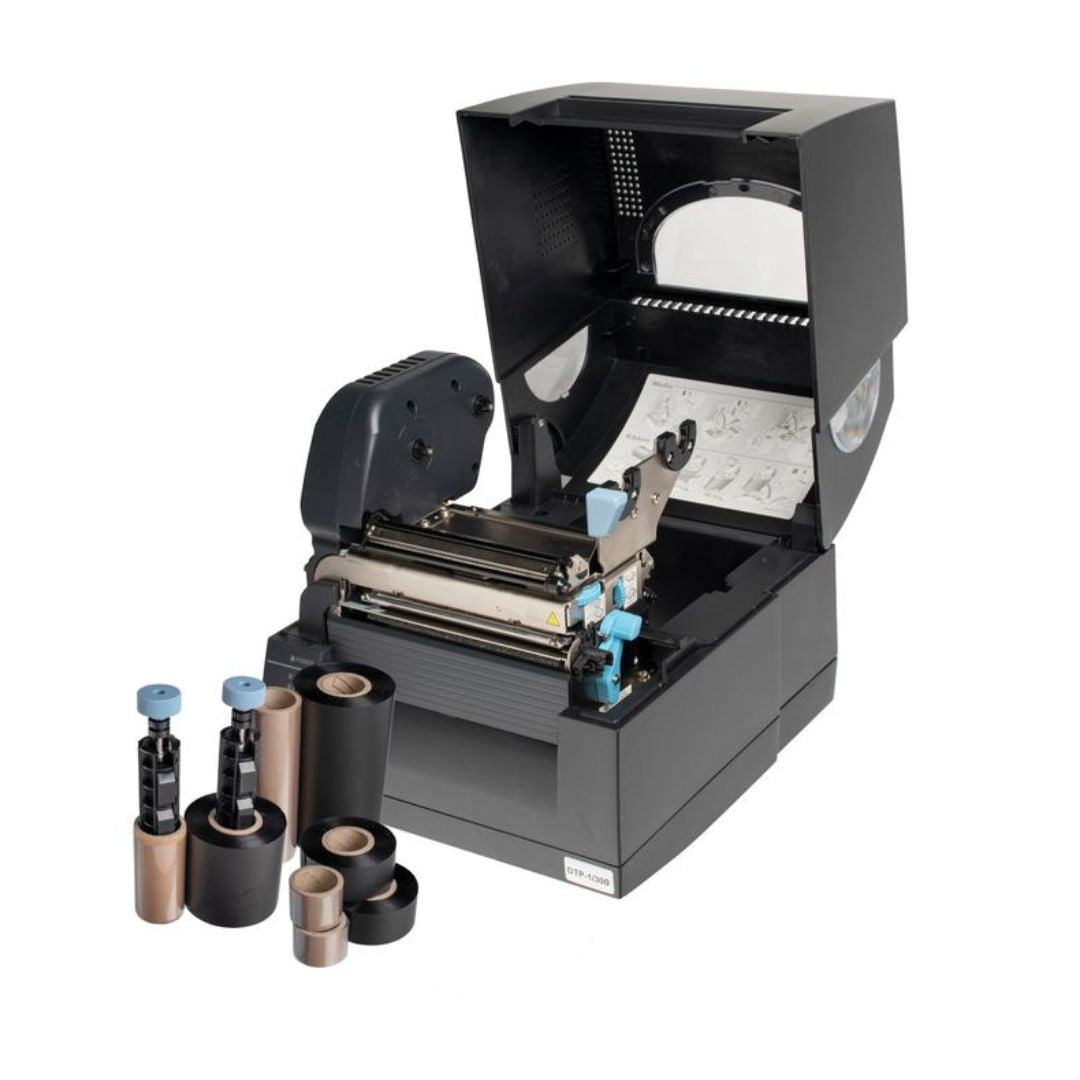
All Silver Fox® thermal labels can be printed using the Fox-in-a-Box® industrial label printer, which uses one software platform, one printer, and one ribbon across the entire product range. For aerospace projects requiring multiple label types across different zones of the aircraft, this means a single labelling system can produce heatshrink markers, tie-on cable labels, wrap-around labels, and asset identification tags without switching equipment. The included Labacus Innovator® software supports barcode and QR code printing, serial number sequencing, and import from wire lists - all essential features for aerospace harness documentation.
FAQ
Common questions about harness labelling
What is the difference between a wiring harness and a wiring loom?
A wiring harness is a bundle of wires bound together following a defined routing path, typically using cable ties or braiding. A wiring loom is a more complex assembly that may combine multiple harnesses or cable assemblies into a single integrated unit. The term "wiring loom" is predominantly used in British and European aerospace contexts, while "wiring harness" is more common in American usage. Both require the same standard of cable labelling for traceability and maintenance.
How do you label wires in an aircraft wiring harness?
Wire marking in aerospace harnesses typically uses heatshrink markers, tie-on cable labels, or 2-part wire marking systems. The specific method depends on the wire diameter, the environmental conditions, and whether the identification needs to be changeable. Heatshrink markers conform tightly to the wire when heat is applied, providing a secure and durable identification. Tie-on labels attach with cable ties and are often used on larger cable bundles.
What standards apply to aerospace cable labels?
Aerospace cable labels are commonly tested to MIL-STD specifications, including MIL-STD-202-215 for chemical resistance, MIL-STD-202G Method 108A for elevated temperature, and MIL-STD-810F for low temperature endurance. The IPC/WHMA-A-620 standard governs the overall quality requirements for cable and wire harness assemblies, including labelling. Specific aircraft programmes may impose additional labelling requirements beyond these baseline standards.
Next steps
Ready to discuss aerospace labelling?
Talk to Silver Fox® About Your Harness Labelling Requirements
Silver Fox® has been manufacturing industrial cable labels in the UK since 1979. Our products are independently tested to MIL-STD specifications and used across aerospace, defence, rail, oil and gas, and data centre sectors worldwide. Whether you need heatshrink wire markers, LSZH tie-on labels, or wrap-around cable identification, we can help you select the right solution for your application.
Contact us at [email protected] or call +44 (0) 1707 37 37 27.
References
Federal Aviation Administration (2024) Advisory Circular AC 43.13-1B: Acceptable Methods, Techniques, and Practices - Aircraft Inspection and Repair. Available at: https://www.faa.gov/regulations_policies/advisory_circulars (Accessed: 5 February 2026).
IPC/WHMA (2017) IPC/WHMA-A-620D: Requirements and Acceptance for Cable and Wire Harness Assemblies. Available at: https://www.ipc.org/ipc-whma-620 (Accessed: 5 February 2026).