
Best Practices
Why Professional Cable Identification Saves Time and Money
Every unlabelled cable is a future problem. Here is why proper cable labelling pays for itself many times over, and how to get it right from the start.
Think about the last time you opened a distribution board, server cabinet, or junction box and found a tangle of unmarked cables. No identification tags, no cable markers, no wire labels. Just a bundle of identical conductors and a sinking feeling.
Now consider how long it took to trace each circuit. Every minute spent identifying an unmarked cable is time not spent on productive work, and in critical environments like data centres, hospitals, or transport networks, those minutes translate directly into lost revenue, safety risk, or regulatory exposure.
Professional cable identification is not an optional finishing touch. It is a fundamental part of any well-managed electrical or data installation, and the return on investment starts the moment you begin labelling.
1. The real cost
What Happens When Cables Are Not Identified
The consequences of poor cable labelling are rarely dramatic in the moment. They accumulate gradually: a few extra minutes here tracing a circuit, a wrong disconnection there during maintenance, a compliance observation from an inspector. Over the lifetime of an installation, these small failures compound into serious costs.
Troubleshooting delays
When a fault occurs, engineers must identify the affected circuit before they can repair it. Without cable labels, this means tone-tracing, visual inspection, or trial-and-error disconnection. What should take seconds can take hours.
Incorrect disconnections
Unlabelled cables in dense installations increase the risk of disconnecting the wrong circuit. In data centres, this can mean unplanned server outages. In electrical systems, it introduces a genuine safety hazard.
Compliance failures
BS 7671 (the IET Wiring Regulations) requires that cables are identified at termination points. Failure to label properly can result in observations during inspection, rework, and project delays.
Knowledge loss
When the original installer leaves or the project changes hands, all that undocumented knowledge walks out the door. The next engineer faces an unmarked installation with no reference.
The investigation into the Baltimore bridge incident highlighted how cable label placement can become a contributing factor in system failures. While that case involved specific circumstances, the broader principle holds: cable identification is not just about tidiness. It is about operational reliability.
2. Where it matters most
Environments Where Cable Identification Is Critical
Cable labelling matters everywhere, but certain environments make the consequences of poor identification especially acute.
Data centres and network infrastructure
Data centres contain thousands of patch cables, fibre connections, and power feeds in tightly packed cabinets. Accurate patch panel labels and cable markers are essential for moves, adds, and changes without disrupting live services. A mislabelled port can mean disconnecting a production server instead of the intended test system.
Electrical distribution
In commercial and industrial electrical installations, cable identification at both ends of each conductor is a requirement under BS 7671. Panel builders, electrical contractors, and maintenance teams rely on clear cable labels to work safely and efficiently. Proper wire identification is not just good practice; it is a regulatory expectation.
Rail and transport
Rail infrastructure demands cable markers and wire labels that meet fire performance standards such as EN 45545-2. In these environments, cable identification must remain legible despite vibration, temperature extremes, and exposure to oils and greases. LSZH (Low Smoke Zero Halogen) materials are typically required, as they produce minimal toxic smoke in the event of fire.
Oil, gas, and offshore
Offshore platforms and petrochemical facilities expose cables to UV radiation, salt spray, chemical splash, and wide temperature ranges. Cable identification tags in these environments must be UV-stable, chemically resistant, and permanently attached. Fox-Flo® LSZH Tie-On Cable Labels are specifically designed for these conditions, combining LSZH compliance with UV stability for outdoor and harsh-environment installations.
Defence and critical infrastructure
Military and critical infrastructure applications require cable identification that survives the most demanding conditions. Silver Fox® has over 45 years of experience supplying cable labels and cable markers to defence applications, and is a member of Make UK Defence.
3. Choosing wisely
Selecting the Right Cable Identification Method
Not all cable labelling methods are equal. The right choice depends on the environment, cable diameter, required durability, and whether labels need to be applied before or after cable installation. Here are the main approaches.
Non-shrink markers
Slide onto cables before termination. Fox-Flo® Non-Shrink Cable Markers are LSZH-compliant and UV-stable, with no heat gun required.
Tie-on labels
Attach to cables of any diameter using cable ties. Ideal for thick cables, bundles, and post-installation labelling where wrap-around labels cannot be applied.
Wrap-around labels
Self-laminating labels that wrap around the cable and protect the print face. Suitable for permanent identification in data and telecoms installations.
For a detailed comparison of all cable label types, including heatshrink markers and flag labels, see our complete guide to cable labels.
Key selection factors
- Environment: indoor, outdoor, subsea, or high-temperature?
- Fire performance: does the application require LSZH materials?
- Cable diameter: can the label be slid on, or does it need to tie on?
- Installation stage: are cables already terminated?
- Longevity: how long must the label remain legible?
4. Speed and accuracy
How Thermal Printing Transformed Cable Labelling
Traditional cable marking methods, such as individual character slide-on markers, require the operator to select each letter or number from a reel and thread it onto the conductor one character at a time. It works, but it is slow, error-prone, and does not scale.
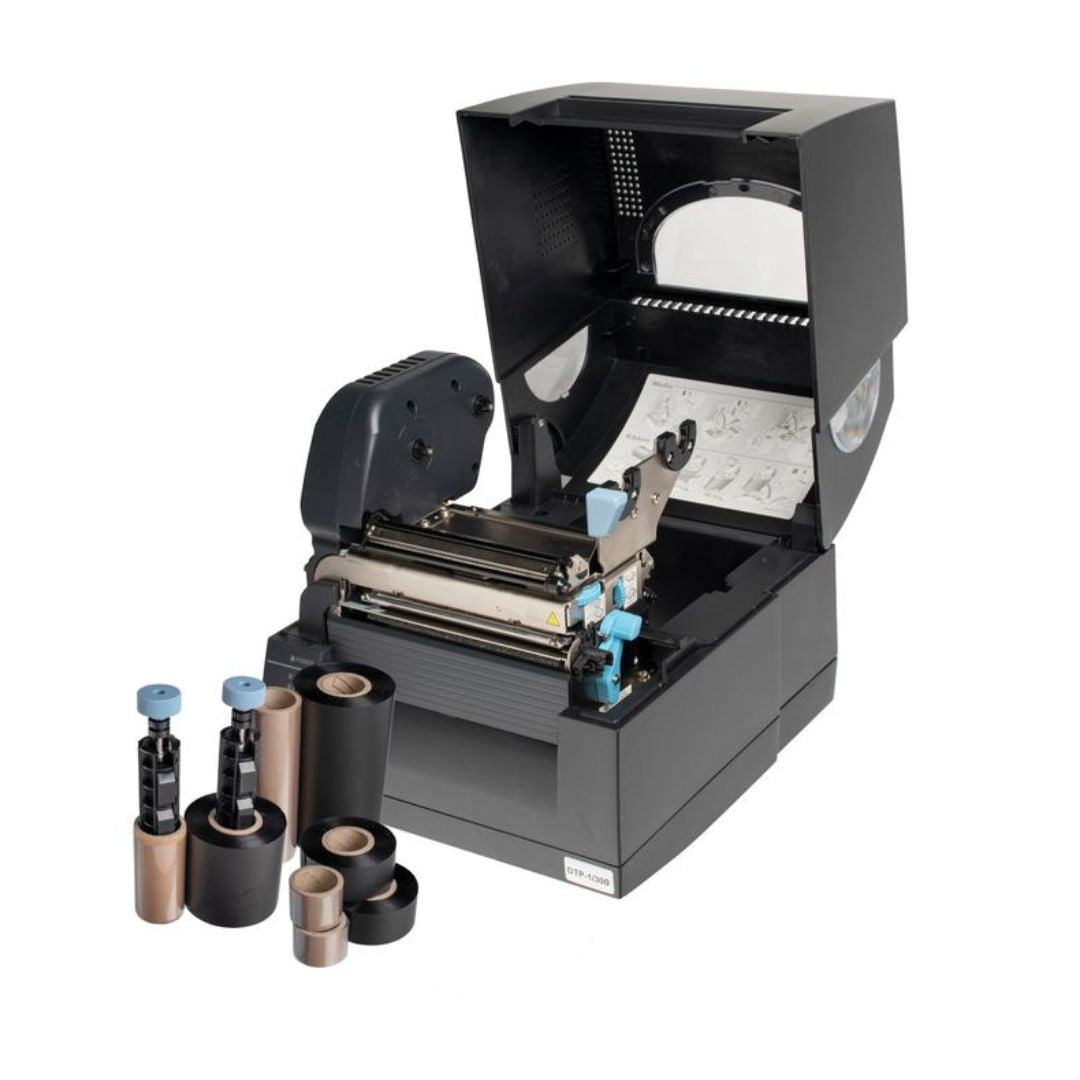
Thermal transfer printing changed this completely. With a Fox-in-a-Box® thermal label printer, you type or import your cable identification data, press print, and the label is ready in seconds. No character selection, no threading, no transcription errors.
These figures come from a time trial conducted at the University of Hertfordshire for Silver Fox®. The test compared applying 50 non-shrink wire markers using traditional slide-on methods against the Fox-in-a-Box® thermal printing system. Traditional methods took 80 minutes for 50 markers. Thermal printing took 5.5 minutes. Use the Time Saving Calculator to estimate savings for your own projects.
Speed is only part of the story. Labacus Innovator® software allows engineers to import cable schedules directly from spreadsheets, auto-serialise cable IDs, and print batch runs of hundreds of labels without re-keying data. This eliminates transcription errors and ensures consistency across entire installations. For data centre projects, Labacus Innovator® also integrates with Fluke LinkWare Live and AEM testing platforms, allowing test results to flow directly into label designs.
The impact on real projects is measurable. Mercury Engineering, one of Europe's leading mechanical and electrical contractors, reduced their data centre cable labelling time from three weeks to three days by switching to Silver Fox®.
5. Common questions
Cable Identification FAQs
Do I need to label cables at both ends?
Yes. BS 7671 requires cable identification at termination points. Labelling both ends ensures that any engineer can trace a circuit without needing to physically follow the cable through containment. It also simplifies maintenance, as circuits can be identified from either end during inspection or fault-finding.
What is the difference between cable labels and cable markers?
Cable labels typically refer to adhesive or tie-on labels attached to the cable exterior. Cable markers are sleeves or tubes that slide onto the cable and sit around the conductor. Both serve the same purpose: permanent cable identification. The best choice depends on cable diameter, environment, and whether the cable is already terminated.
What does LSZH mean and when is it required?
LSZH stands for Low Smoke Zero Halogen. LSZH cable labels produce minimal smoke and no toxic halogen gases when exposed to fire. They are required in enclosed spaces, public buildings, rail, and underground installations where smoke inhalation is a risk. Fox-Flo® labels are LSZH-compliant and suitable for these applications.
Can I print cable labels from a spreadsheet?
Yes. Labacus Innovator® software supports direct import from Excel spreadsheets and CSV files. You can map columns to label fields, auto-serialise cable IDs, and batch print entire cable schedules in minutes. For more detail, see our guide to printing labels from Excel and wire lists.
How do I label fibre optic cables?
Fibre optic cables require flag-style labels that wrap around the thin cable and provide a readable surface without adding bulk. Prolab® Laser Fibre Optic Flag Labels are designed specifically for this application. They can be printed on any standard office laser printer using Labacus Innovator® software.
How long do industrial cable labels last?
Silver Fox® labels are designed to last the lifetime of the installation. Fox-Flo® labels are UV-stable and resist degradation from chemicals, moisture, and temperature cycling. The thermal transfer print is embedded into the label surface, so it does not fade, smear, or rub off like inkjet or direct thermal prints.
Next steps
Start Labelling Smarter
One Printer. One Software. One Ribbon. Every Label You Need.
Fox-in-a-Box® prints cable labels, cable markers, patch panel labels, and equipment tags from a single desktop system. Paired with Labacus Innovator® software, it handles everything from one-off labels to batch runs of thousands, with direct spreadsheet import and cable tester integration.
Silver Fox® has been manufacturing industrial labelling solutions in Hertfordshire since 1979. Every product comes with lifetime free support and training.
Contact us at [email protected] or call +44 (0) 1707 37 37 27.
References
Institution of Engineering and Technology (2022) BS 7671:2018+A2:2022 Requirements for Electrical Installations (IET Wiring Regulations). 18th Edition.
Silver Fox Limited (2026) Cable Labelling Time Savings Calculator. Available at: https://silverfox.co.uk/pages/cable-labelling-time-savings-calculator (Accessed: 11 February 2026).
European Committee for Standardization (2013) EN 45545-2: Railway applications - Fire protection on railway vehicles - Part 2: Requirements for fire behaviour of materials and components.