
Case Study - Industrial IoT & Antenna Manufacturing
Labelling antenna cables for global markets: the Mobile Mark story
How an antenna manufacturer brought CE marking and frequency identification in-house using a Silver Fox® thermal printing system - and why doing it themselves matters when their products end up everywhere from transit fleets to mining vehicles.
Antenna manufacturers face a labelling challenge that is easy to underestimate. The product itself - a wireless antenna - might end up on a fleet vehicle, a public safety radio mast, an industrial IoT gateway, a defence platform, or strapped to one of the giant haul trucks rolling around an open-pit mine. The cable on that antenna has to carry small but critical pieces of information: the CE marking that proves regulatory compliance, and the operating frequency the antenna is designed for. The label has to stay readable in whatever environment the customer puts the product into.
At a glance
Mobile Mark in numbers

Featured in this case study
Mobile Mark
A US and UK antenna manufacturer designing wireless communications antennas operating between 30 MHz and 7.2 GHz, supplying transit, IoT, mining, defence and other markets worldwide.
30 MHz - 7.2 GHz
Operating frequency range
2 countries
Manufacturing sites in the US and UK
Worldwide
Customers across multiple sectors
In-house
Cable labels printed at the point of manufacture
1. Background
An antenna manufacturer with a global customer base
Mobile Mark designs and manufactures antennas for wireless communications systems operating between 30 MHz and 7.2 GHz. The company describes itself as a committed antenna solutions business - a place where employees feel a strong commitment to the company - and its products are sold into transit, industrial IoT, mining, defence, public safety, smart highway, and other connected markets.
That last point is what makes the labelling story interesting. Mobile Mark does not operate the haul trucks, fit the radios, or run the fleet management systems where its antennas eventually end up. Its customers do. And those customers expect to receive antennas that are clearly marked at the cable - showing both CE conformity and the operating frequency - so the right antenna ends up connected to the right radio, and the regulatory paperwork stacks up at every step of the supply chain.
With manufacturing sites in both the United States and the United Kingdom, Mobile Mark's UK operation is responsible for producing antennas destined for European customers and beyond. Cable labelling is a step in the production process that has to happen consistently every time, on every cable, in a way that survives whatever environment the antenna is destined for.
2. The challenge
A small label, a wide range of conditions
The labelling requirement at Mobile Mark is, on the face of it, modest. Each antenna cable needs a small adhesive label carrying the CE mark and the frequency the antenna operates at. The text is short, the format is consistent, and the production volume runs continuously alongside antenna assembly.

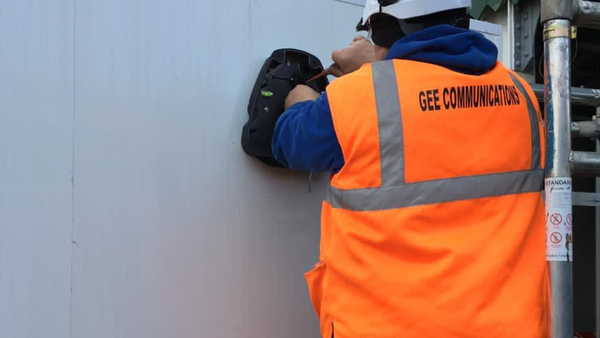
The complication is downstream. The same cable label has to perform on a public-safety vehicle in winter, on a smart-highway gantry, on a connected-fleet truck running long-haul routes, and - in one example shared by Mobile Mark - on a tyre pressure monitoring system fitted to the giant haul trucks used in open-pit mining. That mining application combines dust, vibration, heat, and damp in a single environment, and the antenna keeps reporting tyre pressure to the driver throughout. The label has to keep doing its job too.
Mobile Mark needed a labelling partner whose products would work across that breadth of end-use environments, supplied with reliable lead times so production was never held up waiting for label deliveries, and supported by software that any production team member could pick up quickly without specialist training.
3. The solution
In-house thermal printing on a single platform
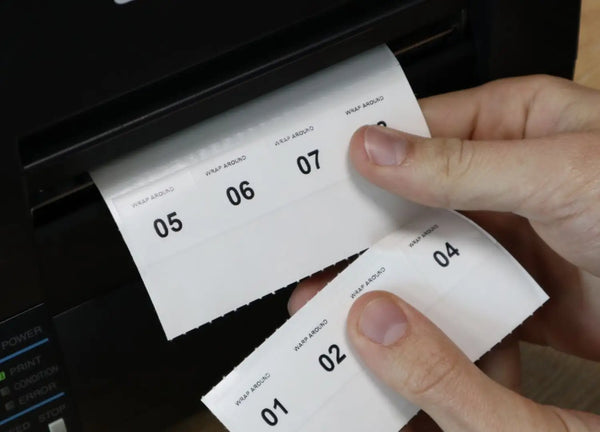
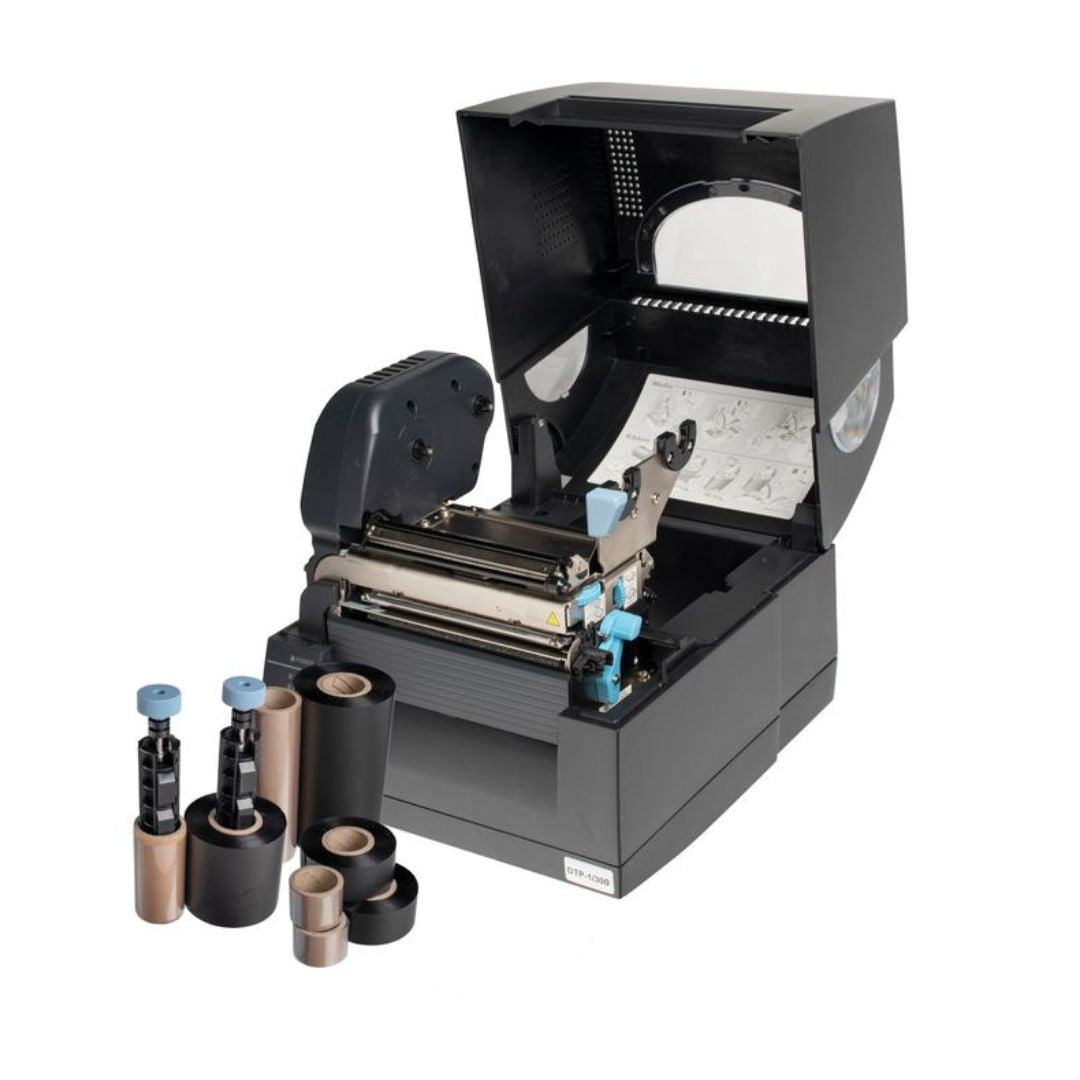
Rather than outsourcing the work or relying on a portable handheld device, Mobile Mark brought cable labelling in-house using a Silver Fox® thermal transfer system. The hardware is the Fox-in-a-Box® industrial label printer; the software is Labacus Innovator®; the labels themselves are Prolab® Thermal Self-Laminating Wrap-Around Cable Labels, applied to each antenna cable as it comes off the line.
Bringing the workflow in-house gives Mobile Mark direct control over what is printed and when. The CE marking is consistent across every product. The operating frequency is correct for the specific antenna model being labelled. And there is no waiting on a third-party print provider when production volumes change or a new antenna variant is introduced.


Labacus Innovator®
Silver Fox®'s label design software handles everything from simple sequential numbering to full spreadsheet imports, barcodes, QR codes, and GS1® Data Matrix encoding. For manufacturers running consistent label formats across long production runs, the combination of templated layouts and easy data entry keeps the labelling step quick and predictable.
4. Why Silver Fox®
Reliability, lead times and approachable software
Asked what led the team to choose Silver Fox®, Mobile Mark cited four factors: reliable supply, competitive pricing, lead times that fit production planning, and a sales and support team that is easy to work with. Software ease of use mattered too. The Fox-in-a-Box® printer and Labacus Innovator® software were both described as straightforward to operate day-to-day.
Aftercare has held up over time. Mobile Mark reports no problems with lead times or delivery, no issues with either the printer or the software, and a support team that follows up to make sure changes, software questions, and ongoing requirements are handled properly.
"After sales service is great - always looking after us and making sure we are happy with any changes, lead times, the software, and support on how to use it if we are unsure."
Mobile Mark
Reliable supply and lead times
Labels and consumables arrive on time, so the labelling step never holds up the wider antenna production schedule.
Easy-to-use software
Labacus Innovator® templates handle the CE marking and frequency text consistently, with no specialist training needed for new operators.
Responsive support
Aftersales contact covers everything from new label specifications to software questions, with the same team across the lifetime of the system.
One printer, one software
A single platform produces every antenna cable label in-house, simplifying operator training and reducing dependency on outside print suppliers.
5. In their own words
A view from the production floor
Asked what other companies looking for a labelling supplier should know about Silver Fox®, Mobile Mark's reply focused on the working relationship rather than any single feature:
"Silver Fox is great to work with and a company that will also work with you regarding the correct product you need and also to find for the items that you sell or want to put them on and will work with the end user for pricing that suits both of them."
Mobile Mark
Asked what they have been most impressed with, the answer was the software and the support shown through each step of the process. Asked how Silver Fox® could improve, Mobile Mark had no feedback to offer - the system in place is doing what it needs to do.
6. Why it matters
A pattern other manufacturers can follow
Mobile Mark's setup illustrates a pattern that suits any OEM, contract assembler, or systems integrator producing equipment for sale into multiple end markets. Three principles are worth pulling out:
- Bring labelling in-house when the data changes per product. CE marking and frequency identification varies by antenna model. Printing on demand from a templated workflow is faster and less error-prone than ordering pre-printed batches for each variant.
- Choose a label that performs across downstream environments, not just yours. The label has to survive whatever the customer's operating environment looks like. Self-laminating wrap-around labels are designed for that role on cables.
- Pick software that any production team member can operate. Specialist labelling software that requires bespoke training becomes a bottleneck. A templated approach inside Labacus Innovator® means trained operators can be brought online quickly.
For manufacturers shipping connected hardware into harsh or regulated end markets, the labelling decision sits inside the wider quality system. Getting it right at the point of manufacture is what keeps the rest of the supply chain moving.
Next steps
Talk to Silver Fox® about your labelling workflow
Bring labelling in-house with one platform
Whether you produce antennas, panels, harnesses, control cabinets, or any equipment that needs identification at the point of manufacture, Silver Fox® can help you specify the right label, printer and software combination for your production line.
Contact us at [email protected] or call +44 (0) 1707 37 37 27 to discuss requirements or request a sample pack.