
Industry Commentary
Nuclear-Powered AI Data Centres: Two Labelling Worlds on One Campus
AtkinsRéalis and Nvidia have announced a partnership to design nuclear-powered hyperscale data centres. For the labelling world, that means a reactor estate and a data centre estate sharing a fence line - and each brings its own identification demands.
1. The news
A nuclear plant and an AI factory, side by side
In March 2026, Canadian engineering firm AtkinsRéalis announced a collaboration with Nvidia to explore the integration of standardised nuclear power solutions, including its CANDU® portfolio, with large-scale AI data centre requirements (AtkinsRéalis, 2026; World Nuclear News, 2026). Dezeen picked up the story in April, placing it in front of an architecture and infrastructure readership and reminding us that the idea of co-located nuclear generation and hyperscale compute has been circulating since at least 2022, when the UK government awarded £210 million to Rolls-Royce to develop Small Modular Reactors (Dezeen, 2026).

The designs are expected to range from 740MWe to 1,000MWe, roughly comparable to the output of a small nuclear reactor (Dezeen, 2026). The argument for co-location is that hyperscale AI sites are outpacing traditional grid connections, and nuclear offers stable, low-carbon baseload generation. AtkinsRéalis has also suggested opportunities to use waste heat from the power plant for cooling, via absorption chillers (Dezeen, 2026).
Whether any of these concepts reaches a concrete slab is another question. But the direction of travel is clear: the next generation of AI infrastructure is being designed as a campus, not a rack. And every campus needs a labelling strategy.
2. The shape of the site
Two estates, two labelling regimes
A co-located nuclear and AI campus is not one labelling environment. It is two, sharing a perimeter.
The nuclear plant estate is one of the most heavily regulated identification environments in industry. Equipment nameplates, valve tags, pipe marking, and instrumentation labelling on a reactor site are governed by nuclear-sector approvals and quality regimes that sit outside the scope of general industrial labelling suppliers. This is specialist territory, procured through qualified supply chains.
The data centre estate is a different discipline. Here the dominant questions are structured cabling identification, patch panel documentation, equipment labelling at hyperscale density, and the software workflows that keep labels matched to test records across tens of thousands of ports. This is the world Silver Fox® has been supplying for more than four decades.
These two worlds only share a site. They do not share a parts bin. Specifiers on these campuses will need to think about labelling as two parallel procurement tracks, with different compliance regimes, different material specifications, and different software workflows running alongside each other.
3. The data centre half
What gigawatt-class AI infrastructure demands from its labels
The data centre half of a nuclear-powered AI campus is still a data centre. It runs on structured cabling, fibre trunks, copper patch, power distribution, cooling pipework, and equipment racks that need unambiguous, durable identification. What scales with compute density is the volume, not the nature, of the labelling task. Three demands rise sharply at gigawatt scale:
LSZH materials for fire safety
Densely populated data halls place a premium on low-smoke, zero-halogen materials. Using non-LSZH accessories in LSZH cable environments undermines the fire-safety rationale of the installation.
Workflow that keeps up with the build
Gigawatt-class sites mean cable counts in the hundreds of thousands. Manual label entry does not scale. The requirement is a tested-to-labelled workflow where test data flows directly into label design.
Standards-aligned identification
The dominant framework for structured cabling identification is the ANSI/TIA-606 family, with TIA-606-D (2021) the current edition. A nuclear-powered AI campus intensifies the need for rigorous, documented adherence.
4. Where we fit
The data centre contractor’s toolkit
Silver Fox® does not claim nuclear-grade equipment labelling. That is specialist supply chain territory, and the right conversation for any nuclear estate is with suppliers qualified under the relevant nuclear quality regimes.
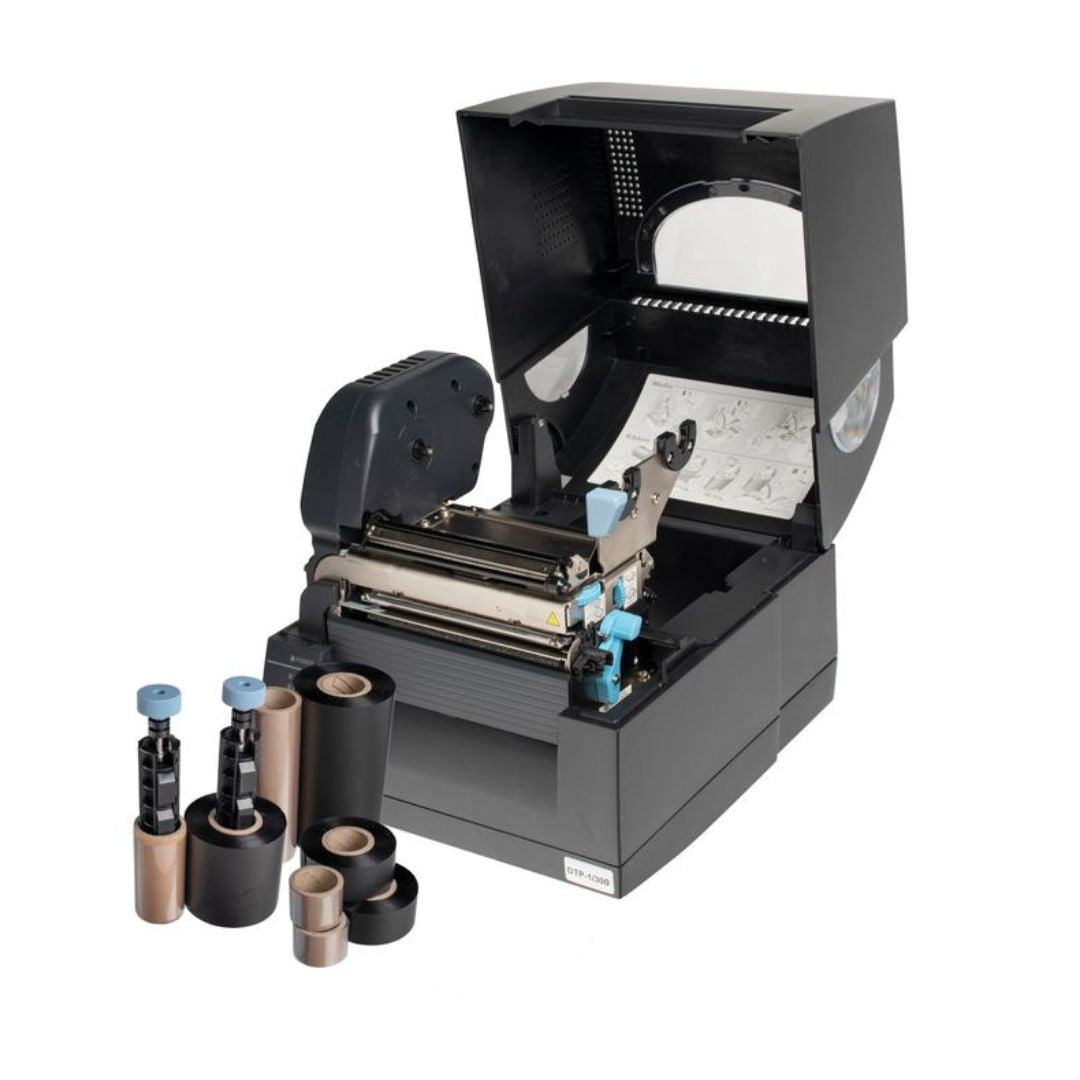
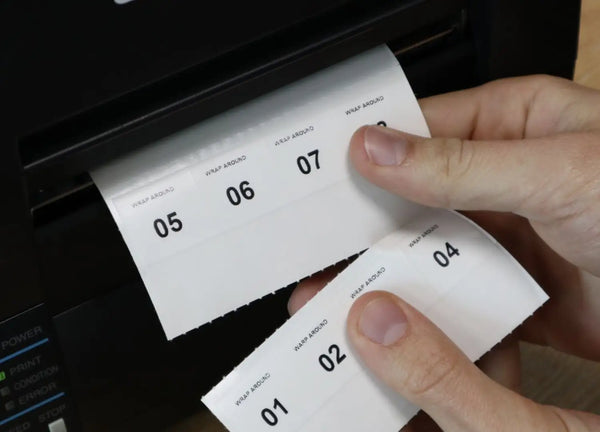
Where Silver Fox® sits is the other half of the campus: structured cabling, equipment labels, and the software workflow that connects a cable test to a printed label. Our Fox-in-a-Box® thermal transfer printing system, paired with Labacus Innovator® software, handles cable and equipment labelling from a single printer, one software, one ribbon, with over 200 label variations.

Labacus Innovator®
Silver Fox®’s label design software handles everything from simple sequential numbering to full spreadsheet imports, barcodes, QR codes, and GS1® Data Matrix encoding. Available in three tiers, with free lifetime updates and support.
For the fire-safety demands of dense, power-intensive halls, Fox-Flo® LSZH tie-on cable labels are designed for environments where low-smoke, zero-halogen materials are specified. Legend™ heatshrink handles wire marking on power and control cables, and the Prolab® range covers patch panels, equipment identification, and asset tagging.
Where the AI factory question gets interesting is integration. Labacus Innovator® integrates with Fluke Networks® LinkWare™ Live and with AEM cable testing platforms, so structured cabling test data can be imported directly into label designs. On a gigawatt-class site, removing manual transcription between test records and labels is not a marginal saving.

Fluke Networks® Integration
Labacus Innovator® integrates with Fluke Networks® LinkWare™ Live, importing cable test results directly into label designs. This eliminates manual data entry for structured cabling projects, reducing errors and connecting physical labels to digital test documentation.

AEM Networks Integration
Labacus Innovator® integrates with AEM cable testing platforms, enabling test-to-label workflows for structured cabling projects. Cable test data can be imported directly, streamlining label production and ensuring consistency between installed cabling records and physical identification.
At hyperscale the serialisation layer matters as much as the materials. Labacus Innovator® Professional generates GS1® Data Matrix codes to the GS1® specification, supporting standardised serialised identification for asset tracking, traceability, and the kinds of digital-twin integrations that tools like Nvidia’s Omniverse are designed to consume.

GS1 UK Approved Partner
Silver Fox® is a GS1 UK Approved Partner. Labacus Innovator® Professional generates GS1® Data Matrix codes to the GS1® specification, supporting standardised serialised identification for asset tracking and traceability.
And on the cooling question specifically: when hyperscale compute moves to immersion-cooled configurations using non-conductive dielectric fluids such as Castrol ON, labels inside the tank meet a different chemical and thermal environment. Silver Fox® offers a dedicated Castrol ON fluid-resistant labels range designed for this use case.

Castrol ON Immersion Cooling
Silver Fox® offers a dedicated Castrol ON fluid-resistant labels range for single-phase immersion-cooled data centres, addressing the changed chemical and thermal environment inside the tank.
5. The wider thread
Critical infrastructure still needs readable labels
There is a through-line across the infrastructure stories we have been tracking: UK Small Modular Reactor supply chains in our post on UK nuclear new build, the 2025 Iberian blackout and its lessons for infrastructure resilience, and now nuclear-powered AI factories.
The lesson is simple. Critical infrastructure depends on clear, durable, readable identification. Software systems and digital twins are powerful design tools, but on a dark data hall floor at 3am, a maintenance engineer is still reading a label on a cable. Making those labels right, at gigawatt scale, across tens of thousands of ports, is a workflow problem. And workflow problems are exactly what Silver Fox®’s integrated system is built to solve.
Next steps
Planning the data centre half of your campus
Talk to us about large-scale data centre labelling
If you are specifying or delivering a hyperscale data centre project, the Silver Fox® team can help with LSZH cable labelling, structured cabling workflows, and Fluke Networks®-integrated label design that scales from one rack to one hundred thousand cables.
Contact us at [email protected] or call +44 (0) 1707 37 37 27.


References
AtkinsRéalis (2026). ‘AtkinsRéalis Collaborates with NVIDIA to Accelerate Deployment of Nuclear-Powered AI Factories’, press release, 16 March. Available at: prnewswire.com.
Dezeen (2026). ‘AtkinsRéalis to partner with Nvidia on nuclear-powered data centres’, 21 April. Available at: dezeen.com.
World Nuclear News (2026). ‘AtkinsRéalis collaborates with Nvidia on nuclear-powered AI factories’, 17 March. Available at: world-nuclear-news.org.