
Industry Guide
Springwell Solar Farm: 800MW of Renewables and Why Every Cable Needs a Label
The UK's largest consented solar project raises a practical question that rarely makes the headlines: how do you identify tens of thousands of cables, components, and assets across a site designed to operate for decades?
On 8 April 2026, the Department for Energy Security and Net Zero granted a Development Consent Order (DCO) for Springwell Solar Farm, an 800MW solar and battery storage project located between Lincoln and Sleaford in North Kesteven, Lincolnshire. Jointly developed by EDF power solutions UK and Luminous Energy, Springwell is designed to generate enough renewable electricity to power over 180,000 homes annually, with electricity export to the national grid planned from 2029 (EDF power solutions UK, 2026; GOV.UK Planning Inspectorate, 2026).
Springwell is the largest generating clean power NSIP approved under the current government and represents a significant milestone in the UK's push toward its Clean Power 2030 target of 45 to 47GW of installed solar capacity, up from approximately 18.1GW in March 2025 (House of Commons Library, 2026; GOV.UK Clean Power 2030 Action Plan, 2024). But projects of this scale bring an engineering challenge that rarely features in planning debates: how do you reliably identify every cable, component, and asset across a site that needs to operate for three to four decades?
1. The pipeline
UK solar farms at a scale never seen before

Springwell joins a growing list of Nationally Significant Infrastructure Projects (NSIPs) that have received development consent in England. Solar Power Portal reports Springwell as the 14th solar NSIP overall (Solar Power Portal, 2026). The table below shows the consented projects verified from GOV.UK, Solar Energy UK, and Solar Power Portal records.
| Project | Capacity | Location |
|---|---|---|
| Little Crow | 150MW | Lincolnshire |
| Fenwick | 237.5MW | Doncaster |
| Mallard Pass | 350MW | Lincolnshire / Rutland |
| Cleve Hill | 373MW | Kent |
| Longfield | 420MW | Essex |
| West Burton | 480MW | Lincolnshire / Nottinghamshire |
| Gate Burton | 500MW | Lincolnshire |
| Heckington Fen | 500MW | Lincolnshire |
| Sunnica | 500MW | Suffolk / Cambridgeshire |
| Tillbridge | 500MW | Lincolnshire |
| Cottam | 600MW | Lincolnshire / Nottinghamshire |
| Springwell | 800MW | Lincolnshire |
Sources: GOV.UK Planning Inspectorate; Solar Energy UK (2024); Solar Power Portal (2025, 2026). Table shows 12 of 14 confirmed solar NSIPs with development consent. Additional projects including Botley West (840MW, Oxfordshire) are awaiting a decision from the Secretary of State.
The government's Solar Roadmap, published in mid-2025, confirmed the ambition to reach 45 to 47GW of solar capacity by 2030 and set out a series of actions to accelerate deployment across rooftop, commercial, and ground-mounted solar (GOV.UK Solar Roadmap, 2025). The UK's total installed solar capacity reached 20.2GW during 2024 and continued to grow through 2025, with over 2GW added in the first half of the year alone, the strongest start to a year in a decade (Carbon Brief, 2025; Solar Power Portal, 2025). Cleve Hill, the first solar NSIP to become fully operational at 373MW, switched on in July 2025 (Solar Media Market Research, 2025).
What all of these projects share is scale, outdoor exposure, long operational lifetimes, and a requirement for tens of thousands of individually identified cables, components, and assets. That is where labelling moves from an afterthought to a critical engineering discipline.
2. The challenge
Why solar farms need industrial-grade labels
A utility-scale solar farm is an electrical installation, and like any electrical installation, it is subject to BS 7671 (the IET Wiring Regulations), which requires cables to be identifiable at their terminations and, where practicable, throughout their length. IEC 62446 adds further requirements specific to photovoltaic systems, including warning labels on DC isolators, junction boxes, inverters, and consumer units (IET, 2018; IEC, 2016).
On a site like Springwell, that means labelling DC string cables from panel arrays to combiner boxes, AC collection cables from inverters to substations, distribution boards, isolators, switchgear, transformers, and every piece of safety signage required by regulation. Each string in the DC field needs a unique identifier so that maintenance teams can trace faults decades after commissioning. Equipment labels on inverters and combiner boxes need to survive the same outdoor environment as the panels themselves.
The practical problem is that standard adhesive labels, the kind printed on an office laser or inkjet printer, degrade rapidly in sustained outdoor exposure. UV radiation breaks down both the print and the substrate. Temperature cycling between sub-zero winter nights and summer heat softens adhesives and causes labels to lift, curl, and eventually fall off. Within months, a label that was legible at commissioning can be unreadable, and with it goes the ability to trace a fault quickly or carry out safe isolation.
The UV challenge in numbers
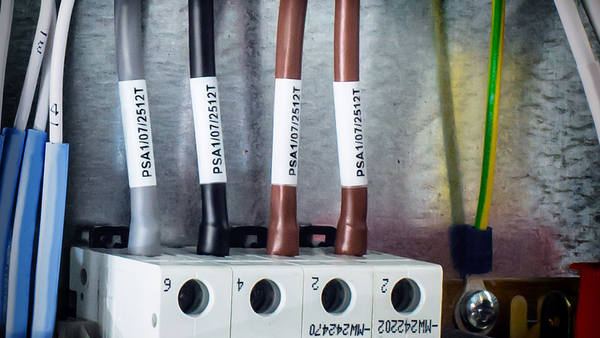
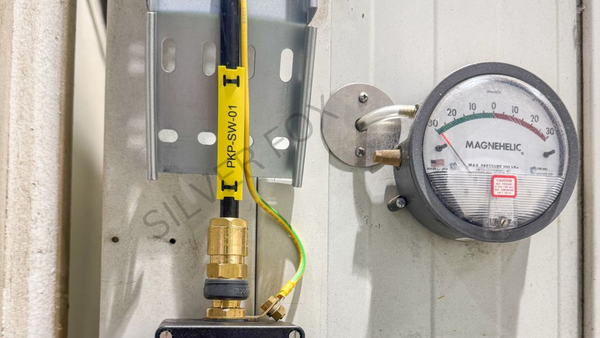
Fox-Flo® UV Stable LSZH tie-on cable labels have undergone 8,000 hours of accelerated UV testing, equivalent to approximately 12 to 15 years of outdoor exposure in a Northern European climate. They are designed for long-term use in exactly the conditions found on solar farms: sustained sunlight, rain, frost, and temperature cycling.
Solar farms also include Battery Energy Storage Systems (BESS), which store excess energy for dispatch when generation drops. Springwell includes battery storage as part of its DCO. BESS enclosures are confined spaces where fire performance matters. Cables in these environments should carry Low Smoke Zero Halogen (LSZH) identification. Fox-Flo® labels are manufactured from LSZH material and are plenum rated, making them suitable for use in BESS enclosures where low toxicity in the event of fire is a key requirement.
Inside the inverter stations, substations, and auxiliary buildings on a solar farm, distribution boards and switchgear panels require circuit-level identification. Every outgoing way needs a clear, durable marker so that maintenance teams can isolate circuits safely and trace faults without ambiguity. Legend™ Non-Shrink Tubing is suited to this environment: it is threaded onto individual conductors during wiring and provides a printed identifier that remains legible inside enclosures where UV exposure is not the primary concern, but heat, vibration, and long service life still matter. For general cable identification inside these protected environments, Legend™ Thermal Tie-On Labels provide a fast, versatile option that can be printed and applied on site as circuits are commissioned.
3. At scale
Labelling thousands of strings, assets, and components
The volume of labels required on a large solar farm is significant. Each DC string connecting a series of panels to a combiner box carries a unique identifier. Each combiner box, inverter, transformer, and section of switchgear requires equipment labels. Asset tags on major components link physical hardware to maintenance records and O&M handover documentation. Safety signage at isolators, junction boxes, and perimeter fencing adds further volume.
Pre-ordering all of these labels from an external print house before construction begins is one approach, but it assumes the design is finalised and no changes occur during installation. On large infrastructure projects, string layouts, equipment locations, and numbering schemes frequently evolve. On-site printing with a thermal transfer system gives EPC contractors the flexibility to produce labels as needed, respond to design changes, and avoid the delays and waste associated with pre-printed labels that no longer match the as-built configuration.

Labacus Innovator®
Silver Fox®'s label design software handles sequential numbering across thousands of string identifiers, spreadsheet imports from design documentation, and barcode, QR code, and GS1® Data Matrix encoding for asset tags. Available in three tiers, with free lifetime updates and support.
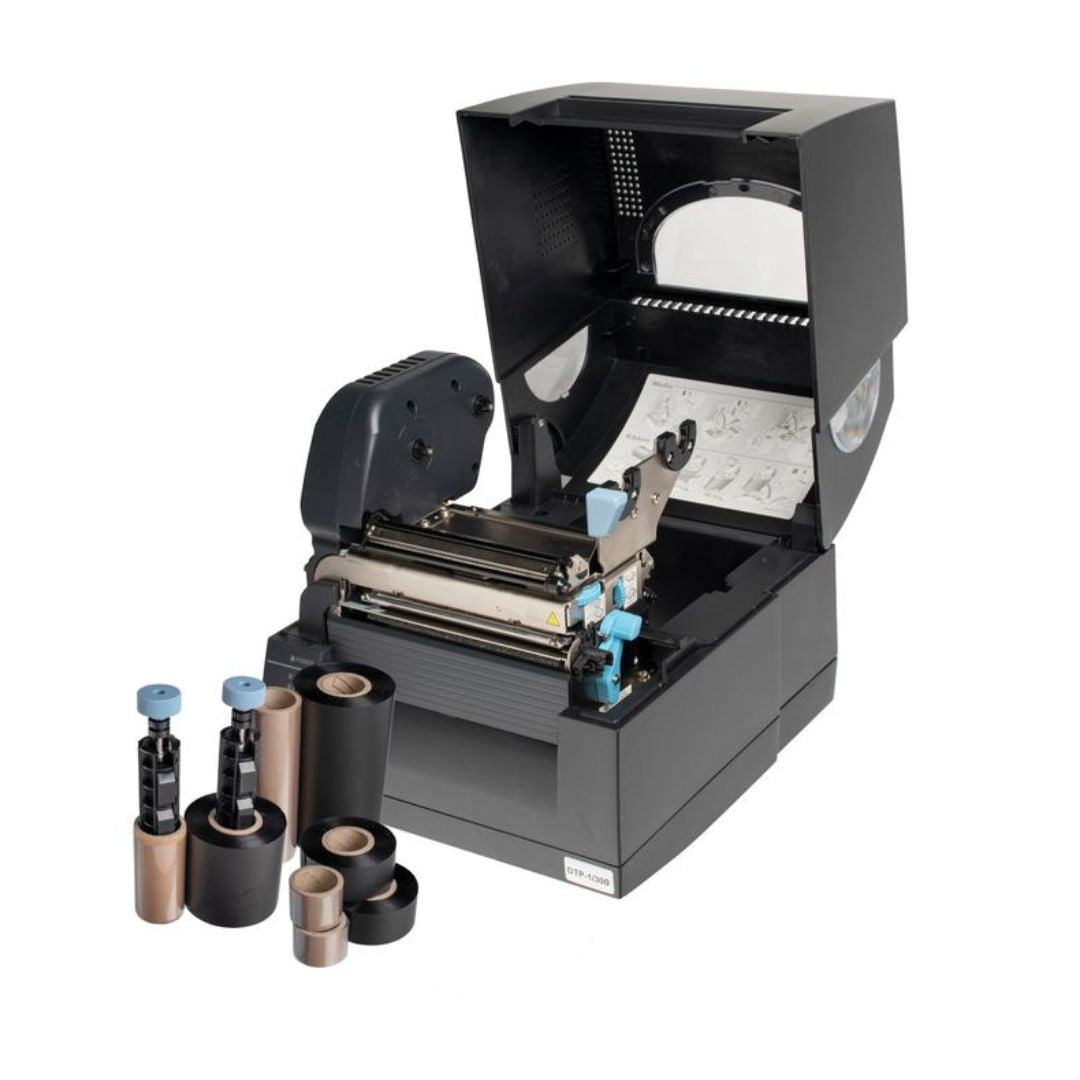
The Fox-in-a-Box® thermal transfer printer produces cable labels, equipment labels, asset tags, and heatshrink markers from a single desktop unit using one software package, one printer, and one ribbon. For solar EPC contractors, this means the same system that prints Fox-Flo® tie-on labels for outdoor DC string cables can also produce Legend™ Non-Shrink Tubing for distribution board circuits, Prolab® Equipment Labels for inverters, and Prolab® Raised Profile Asset Labels for components that need to be tracked through the operational lifetime of the plant. Switching between label types takes seconds, with no ribbon change required.
FAQ
Common questions
What labelling standards apply to solar farms in the UK?
BS 7671 (the IET Wiring Regulations) requires cables to be identifiable at terminations and, where practicable, throughout their length. IEC 62446 specifies additional labelling requirements for photovoltaic systems, including warning labels on DC isolators, junction boxes, and inverters. Safety signage requirements also apply under the Electricity at Work Regulations 1989.
How long do solar farm labels need to last?
Solar farms have a typical design life of 30 to 40 years (House of Commons Library, 2026). Fox-Flo® labels have undergone 8,000 hours of accelerated UV testing, equivalent to approximately 12 to 15 years of outdoor exposure in a Northern European climate. This is significantly longer than standard labels, which can degrade within months outdoors. For components in sheltered environments such as inverter enclosures and distribution boards, label life can extend further as UV exposure is reduced. Where labels are exposed to full outdoor weathering for the entire asset lifetime, planned replacement as part of routine maintenance cycles may be appropriate.
Do BESS enclosures on solar farms require LSZH labels?
BESS enclosures are confined spaces where fire performance is a consideration. Using LSZH cable identification in these environments supports the goal of minimising toxic fume release in the event of fire. Fox-Flo® labels are manufactured from LSZH material and are plenum rated.
Can labels be printed on-site during solar farm construction?
Yes. Thermal transfer printers such as the Fox-in-a-Box® are desktop systems that can be set up in a site office. They produce cable labels, equipment labels, asset tags, and heatshrink markers from a single unit, allowing EPC contractors to respond to design changes and produce labels as needed rather than relying entirely on pre-ordered stock.
Next steps
Specify labelling for your solar project
Talk to Silver Fox® about solar farm labelling
Whether you are specifying labels for a new solar NSIP, upgrading identification on an existing installation, or looking for a labelling system that handles cables, equipment, and assets from a single workstation, our team can help you choose the right materials and workflows for your project.
Silver Fox® has supported power and renewables projects including Hinkley Point C, and our labels are trusted by electrical and instrumentation engineers across the energy sector.
Contact us at [email protected] or call +44 (0) 1707 37 37 27.

References
EDF power solutions UK (2026). Major milestone as Government grants Development Consent Order for Springwell Solar Farm. Available at: edf-powersolutions.uk [Accessed 9 April 2026].
GOV.UK Planning Inspectorate (2026). Springwell Solar Farm development consent decision announced. Available at: gov.uk [Accessed 9 April 2026].
North Kesteven District Council (2026). Springwell Solar Farm. Available at: n-kesteven.gov.uk [Accessed 9 April 2026].
House of Commons Library (2026). Planning for solar farms. Research Briefing CBP-7434. Available at: commonslibrary.parliament.uk [Accessed 9 April 2026].
GOV.UK (2024). Clean Power 2030 Action Plan: A new era of clean electricity. Available at: gov.uk [Accessed 9 April 2026].
GOV.UK (2025). Solar Roadmap: United Kingdom powered by solar. Available at: gov.uk [Accessed 9 April 2026].
Solar Energy UK (2024). Approval of UK's largest solar project 'another step in the right direction' says industry. Available at: solarenergyuk.org [Accessed 9 April 2026].
Solar Power Portal (2025). UK's biggest solar farm gets development consent order. Available at: solarpowerportal.co.uk [Accessed 9 April 2026].
Solar Power Portal (2025). Westminster approves 800MW solar farm in Lincolnshire. Available at: solarpowerportal.co.uk [Accessed 9 April 2026].
GOV.UK Planning Inspectorate (2025). Tillbridge Solar Project development consent decision announced. Available at: gov.uk [Accessed 9 April 2026].
Carbon Brief (2025). Analysis: UK's solar power surges 42% after sunniest spring on record. Available at: carbonbrief.org [Accessed 9 April 2026].
IET (2018). BS 7671:2018 Requirements for Electrical Installations (IET Wiring Regulations). 18th Edition.
IEC (2016). IEC 62446-1:2016 Photovoltaic (PV) systems - Requirements for testing, documentation and maintenance.