
Selection Guide
Equipment Labels: Choosing the Right Material for Every Environment
From office IT racks to outdoor plant, the right equipment label depends on the environment it needs to survive. Here is how to match materials to conditions and print asset labels on demand.
Every piece of equipment in a building, plant, or data centre needs a label. Without one, it is invisible to the maintenance team, the auditor, and the asset register. A pump with no tag gets skipped during a service round. A server with no label gets logged against the wrong rack. A distribution board with no circuit ID causes confusion every time someone opens the door.
Equipment labels solve all of these problems, but only if they stay put and stay legible for the life of the asset. A label that peels off a heat exchanger six months in is worse than no label at all. It leaves a gap in the records that nobody spots until something goes wrong.
This guide covers the practical side of choosing equipment labels and asset labels for UK sites. You will learn which materials work where, how to match the label to the conditions, and how to print labels on demand.
1. Label types
The Equipment Label Escalation Ladder
Not every piece of equipment needs the same label. A monitor on an office desk has very different requirements from a junction box on an exposed rooftop. Silver Fox® offers a range of equipment label types that form a clear escalation path. Start with the lightest-duty option that suits the environment, and step up when conditions demand more.
Level 1: Prolab® P/TAG Equipment Labels
Prolab® P/TAG Equipment Labels are laser-printable polyester labels on pre-cut A4 sheets. They print on any standard office laser printer, so there is no need for specialist kit. You can print up to 504 labels in the time it takes one A4 sheet to pass through the printer. P/TAG labels use a strong acrylic adhesive and come in sizes from 12x12mm up to full A4 sheets. The finished labels have been tested to 85°C for 1,000 hours, and white labels have been tested for 3,000 hours of accelerated UV ageing. For most indoor sites, plant rooms, and sheltered installs, P/TAG labels are the practical starting point.
For larger identification requirements, Prolab® A5 Equipment Labels and Prolab® A4 Equipment Labels provide half-sheet and full-sheet polyester labels suitable for cabinet identification, large panel designations, and mimic diagrams.
Level 2: Prolab® Clear Asset Labels
Prolab® Clear Asset Labels offer discreet identification where the label needs to blend with the equipment surface. They can also be applied over a P/TAG or printed label as a protective lamination layer, adding an extra barrier against abrasion, moisture, and light chemical contact. This makes them a flexible option for extending the life of any existing label.
Level 3: Prolab® Low Profile Asset Labels
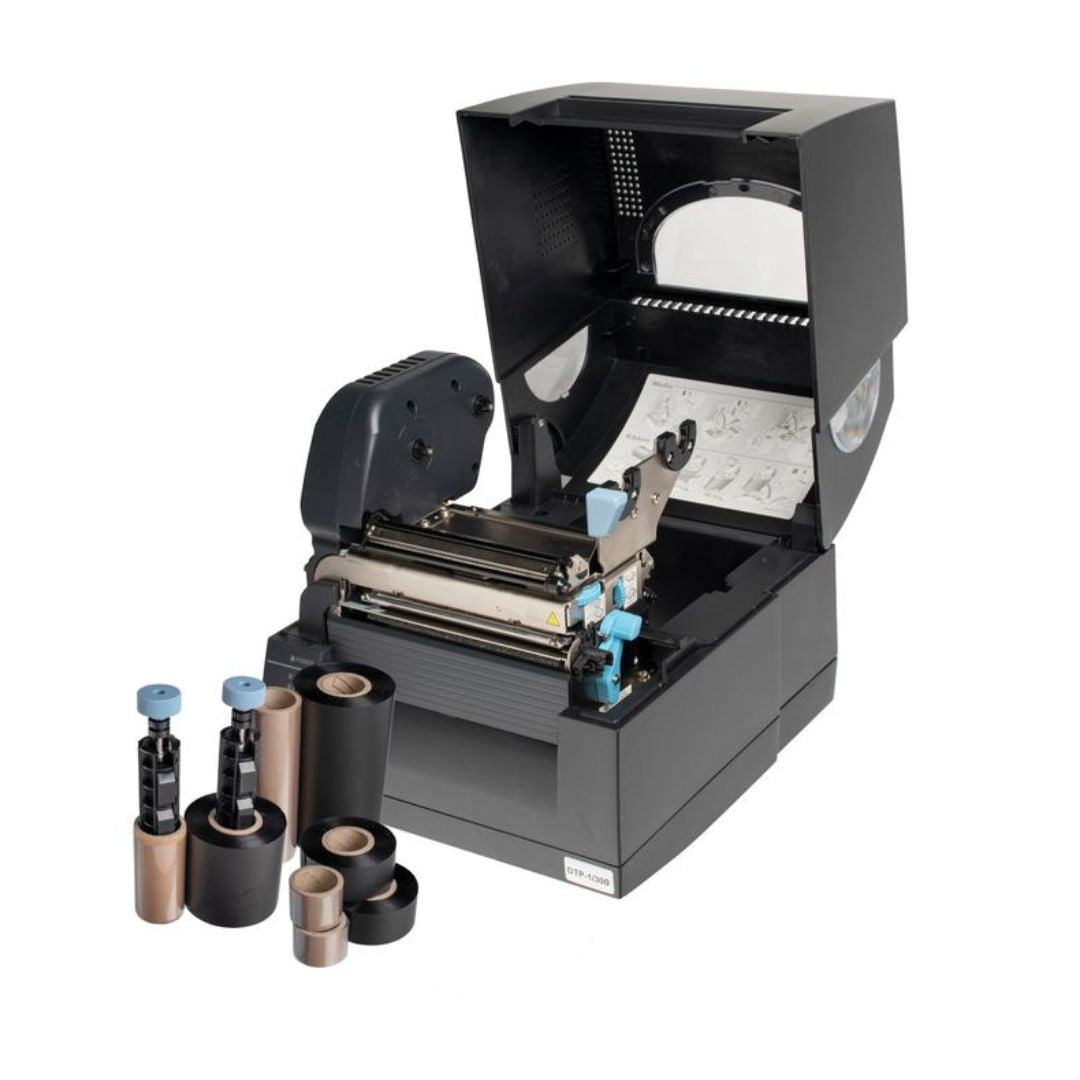
Prolab® Low Profile Asset Labels are made from metalised polyester and sit flat against the surface. They print using the Fox-in-a-Box® thermal transfer printer. The metalised finish gives a professional look that suits IT racks, control panels, and indoor industrial kit where you need a step up from standard polyester.
Level 4: Prolab® Raised Profile Asset Labels
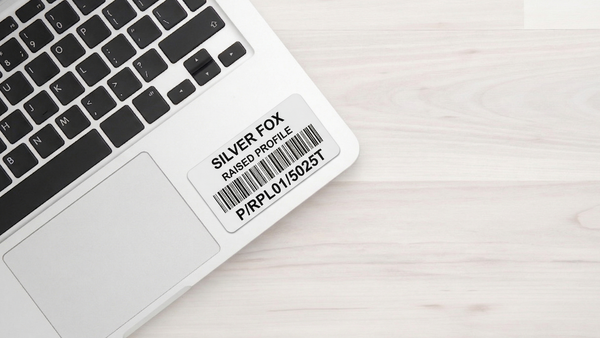
Prolab® Raised Profile Asset Labels use a polyester face on a foam carrier with a permanent acrylic adhesive. The raised build gives a high-visibility, rugged finish. These labels are designed to resist abrasion, solvents, and rough handling. They are the label of choice for tools, plant machinery, outdoor enclosures, and any surface that gets bumped, scraped, or cleaned with chemicals.
Level 5: Clear over Raised or Low Profile
For the best printed label protection, apply a Prolab® Clear Asset Label over a Raised Profile or Low Profile label. This adds a barrier against UV, chemical splash, and abrasion without changing the label beneath it.
Level 6: Endurance® Engraved Labels
When marking must last for the full life of the equipment with no risk of fading or peeling, Endurance® Engraved Labels are the answer. Text and graphics are cut into the material itself: traffolyte, acrylic, stainless steel, or aluminium. There is no ink or print to wear away. Traffolyte labels have been tested to meet the needs of LUL1-085 for London Underground. Engraved labels are the standard for permanent nameplates, safety-critical marking, and any asset with a decades-long service life. They are made to your spec at the Silver Fox® factory in Hertfordshire.
2. Environments
Matching Materials to Conditions
The right equipment label starts with the environment. A label that works perfectly in an air-conditioned server room will fail within months on an outdoor pump housing. Here is how each label type maps to common UK environments.
Office & IT
Controlled temperature, no chemical exposure, minimal handling. P/TAG Equipment Labels or Clear Asset Labels are the standard choice. Low Profile for a professional metalised finish.
Indoor Industrial
Plant rooms, switchgear, distribution boards. P/TAG for general use. Low Profile for higher durability. Raised Profile where equipment is subject to regular handling or solvent cleaning.
Outdoor & Harsh
UV exposure, rain, temperature cycling. Raised Profile with Clear lamination for printed labels. Endurance® Engraved for permanent identification that will not fade or degrade.
For a deeper look at how labels perform in extreme conditions, including UV, temperature, and chemical exposure, see our guide to durable labels for harsh environments.
Choosing tip
- If the equipment is indoors and rarely touched, start at Level 1 (P/TAG).
- If the label will be handled, cleaned, or exposed to solvents, step up to Level 4 (Raised Profile).
- If the label must survive for 20+ years with zero maintenance, go to Level 6 (Engraved).
3. Printing
Laser vs Thermal Transfer: Two Routes to Printed Equipment Labels
Silver Fox® supports two in-house printing methods for equipment labels. The right choice depends on the range of label types you need, the environments your labels will face, and how often you print.
Laser Printing
Use your existing office laser printer. No specialist hardware needed. Covers P/TAG Equipment Labels, A4 and A5 sheets. Ideal for indoor and sheltered environments, smaller volumes, and teams getting started with in-house labelling. For a full overview of the laser range, see our guide to laser printable labels.
Thermal Transfer
The Fox-in-a-Box® thermal transfer printer opens up the full Silver Fox® label range: over 200 label types from one compact system. Resin ribbon bonds to the label surface, giving print that is designed to resist abrasion, solvents, and UV. The stronger option for kit in tough spots.

Labacus Innovator®
Silver Fox®'s label design software drives both laser and thermal printing. Templates for every label in the range are built in. At Advanced and Professional tiers, it supports CSV import, Fluke Networks® LinkWare™ Live integration, and sequential numbering. The Professional tier adds barcodes, QR codes, and GS1® Data Matrix encoding.
Many organisations use both routes. Laser printing covers quick batches of P/TAG labels from the office, while the Fox-in-a-Box® handles the full range on site. Both are driven by the same Labacus Innovator® software, so label designs, numbering sequences, and imported data are consistent regardless of the printing method. For a detailed comparison of in-house printing vs ordering pre-printed labels, see our guide to printing your own asset tags.
4. Digital integration
Adding Barcodes, QR Codes, and Logos
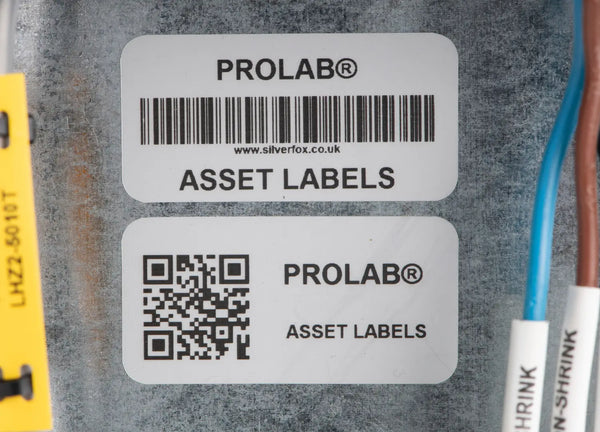
A plain text label tells you what a piece of equipment is. A label with a scannable code links it to everything your team knows about that asset: purchase date, service history, warranty, location, and who is responsible for it.
Labacus Innovator® Professional supports all the main code types: 1D barcodes (Code 128), QR codes, and GS1® Data Matrix. Silver Fox® is a GS1 UK Approved Partner, supporting the GS1® standard for serialised asset IDs. For a full guide on when to use barcodes vs QR codes, see our post on barcodes and QR codes on cable and equipment labels.

GS1 UK Approved Partner
Silver Fox® is a GS1 UK Approved Partner. Labacus Innovator® Professional generates GS1® Data Matrix codes to the GS1® specification, supporting standardised serialised identification for asset tracking and traceability.
Need branded asset labels with a company logo? Labacus Innovator® Professional can import graphics and place them alongside text, codes, and numbering. This is handy for multi-site teams or managed service providers who need clear ownership on every tag.
5. Applications
Where Equipment Labels Go
Equipment labels are used across every sector where assets need to be identified, tracked, and maintained. Here are the most common applications.
- Control panels and switchgear: circuit IDs, isolator labels, and panel legends. BS 7671 (the IET Wiring Regulations) says every circuit at a distribution board must be labelled in a durable, clear way. P/TAG labels are widely used for panel schedules; engraved traffolyte gives permanent legends for switchgear.
- IT racks and data centres: server IDs, patch panel labels, PDU marking, and rack location codes. Low Profile and Clear labels give a clean finish in structured cabling setups. For a step-by-step guide, see our post on labelling IT equipment for asset tracking.
- Plant and mechanical equipment: pumps, compressors, HVAC units, valves, and pressure vessels. Raised Profile labels handle vibration, oil splash, and cleaning solvents. Engraved stainless steel nameplates suit kit with a 20-year-plus service life.
- Outdoor and exposed sites: substations, rooftop plant, solar arrays, EV charging points. Raised Profile with Clear lamination gives UV and weather protection for printed labels. Engraved aluminium or stainless steel suits permanent outdoor assets.
- Tools and portable kit: test gear, power tools, and field instruments. Raised Profile labels grip the textured, curved surfaces common on tool housings.
The common thread is that every label must match the conditions it faces. Starting at the right level of the escalation ladder means labels stay attached and legible for the life of the asset, rather than needing replacement every few months.
6. FAQ
Common Questions About Equipment Labels
What are equipment labels?
Equipment labels are ID tags stuck to physical assets like control panels, IT kit, plant machines, and tools. They link each piece of kit to its record in a service system or asset register, so it can be found, serviced, audited, and tracked.
What is the difference between equipment labels and cable labels?
Cable labels mark cables and wires, usually with tie-on, heatshrink, or wrap-around formats. Equipment labels mark the assets: the panel, the rack, the pump, the device. Most sites need both. The Fox-in-a-Box® prints cable labels and equipment labels from the same system, so both stay in sync.
Can I print equipment labels on a standard office printer?
Yes. Prolab® P/TAG Equipment Labels are made for standard office laser printers. They come as pre-cut A4 polyester sheets that print just like paper. No special kit or ink is needed. Labacus Innovator® Lite is free and includes templates for every label size in the range.
How do I choose between laser and thermal transfer printing?
Laser is the simplest start: use your office printer with P/TAG sheets. Thermal transfer via the Fox-in-a-Box® gives you the full label range, including Low Profile, Raised Profile, and cable labels, with tougher print that is designed to resist solvents and UV. Many teams use both.
Can I add our company logo to equipment labels?
Yes. Labacus Innovator® Professional can import graphics like logos, compliance marks, and custom symbols. You can place them next to text, barcodes, and numbering on any label in the range.
Next steps
Find the Right Label for Your Equipment
Browse the Full Equipment Label Range
Explore the asset labels and equipment labels collection to compare formats, sizes, and materials. If you need help matching a label to a specific environment, our technical team can advise.
For large projects or custom requirements, Silver Fox® also offers a Pre-Print Service where we produce your labels to specification, ready to apply on arrival.
Contact us at [email protected] or call +44 (0) 1707 37 37 27.

References
BSI (2018). BS 7671:2018+A2:2022 - Requirements for Electrical Installations (IET Wiring Regulations). British Standards Institution.
IEC (2008). IEC 62491 - Industrial cables - Marking and identification of cores and cables for cable connections. International Electrotechnical Commission.