
Cable Labelling Guide
The Complete Guide to Cable Labels
How to choose, print, and apply cable labels that last. Covers label types, cable identification strategies, readability, and colour coding for electrical, data, and industrial environments.
Cable labelling is one of those tasks that rarely gets the attention it deserves until something goes wrong. An unlabelled cable tray turns a simple repair into hours of tracing. A faded label on a power cable forces an engineer to test every circuit before isolating a fault. In the worst cases, poor cable identification creates genuine safety risks.
Whether you are labelling cables in a data centre, on a construction site, or inside a control panel, the principles are the same: choose the right label type for the environment, include the right information, and apply it consistently. This guide covers everything you need to know about cable labels, from the different types available to building a cable identification strategy that your whole team can follow. For a practical walkthrough of the labelling process itself, see our step-by-step guide to labelling terminated wires.
1. Label types
Cable Label Types Explained
Not all cable labels are the same. The right choice depends on your environment, the cable diameter, whether you are labelling before or after termination, and any compliance requirements. Here is an overview of the main cable marker types used in industrial and commercial settings.
Tie-On Cable Tags
Attached to the cable using a cable tie. Available in materials ranging from PVC to UV-stable LSZH. Ideal for both pre-terminated and post-terminated cables, and suitable for a wide range of cable diameters. Fox-Flo® tie-on labels are a popular choice for harsh or outdoor environments thanks to their UV stability and LSZH construction.
Wrap Around Labels
Self-laminating labels that wrap around the cable and seal over the printed area, protecting it from dirt, moisture, and abrasion. Best suited to data cabling and network environments. For a detailed guide to when and how to use them, see our wrap around cable labels guide.
Heatshrink Markers
Shrinkable tubing that conforms tightly to the cable when heat is applied. Provides a permanent, tamper-resistant identification that is ideal for environments with vibration or movement. Available in LSZH and premium grades with shrink ratios of 2:1 or 3:1. Legend™ LSZH Ladder Heatshrink markers are a good option for rail and safety-critical applications.
Flag Labels
Small labels that stick to themselves around a cable, leaving a protruding flag that is readable from multiple angles. Particularly useful for fibre optic patch cords and densely packed cable runs. Prolab® Laser Fibre Optic Flag Labels are designed specifically for this purpose, with dual-sided printing capability.
Other cable marking methods include tie-on wire markers and non-shrink tubing that grips the cable without requiring heat. Each method has trade-offs between speed of application, durability, and flexibility. The choice often comes down to whether you are labelling before or after termination, and how much handling the cables will see over their lifespan.
Should you use self-laminating wraps or plain wraps? Self-laminating labels, like Prolab® Laser Self-Laminating Wrap-Around Cable Labels, include a clear protective tail that seals over the printed area. This protects against smudging, chemicals, and moisture, making them the better choice for most professional installations where long-term readability matters.
2. Information
What Information Goes on a Cable Label
A cable label needs to carry enough information for fast troubleshooting without becoming cluttered and unreadable. The minimum information required depends on your application, but as a general rule, a technician should be able to identify where the cable goes and what it carries without consulting separate documentation.
Common Cable Label Information
- Unique cable identification number or code
- Source and destination (endpoints)
- Service type where relevant (voice, data, OT, safety)
- Voltage class for power cables (LV, HV)
- Circuit or feeder number
- Loop number or instrument tag for E&I installations
How much detail you include depends on the complexity of the installation. In a small commercial fit-out, a simple cable number referencing both endpoints may be sufficient. In a large industrial plant or data centre, cable tags often carry service type, voltage class, and destination information to enable quick fault-finding. For data centre environments specifically, labelling conventions like ANSI/TIA-606 provide a framework for structured cable identification that covers patch panels, horizontal links, and backbone cabling.
The key principle is this: label both ends of every cable with the same identifier. If a technician can read the cable label at one end and immediately know where the other end terminates, you have succeeded. Everything beyond that is useful detail, not a replacement for the basics.
3. Cable ID strategy
Building a Cable Identification Strategy
A cable identification strategy goes beyond choosing what to print on each label. It defines how cable numbers are assigned, what happens when cables are replaced, and how the labelling system maps to your documentation.
Endpoint encoding vs. unique cable IDs
There are two common approaches to cable naming. The first encodes the endpoints directly onto the cable label, for example DB-R3-P12 meaning "Distribution Board, Rack 3, Port 12." This makes the label self-explanatory but creates problems when ports change: you either relabel the cable or live with inaccurate labels.
The second approach assigns each cable a unique identifier (for example, C-00412) and maps the endpoints in a separate cable schedule or database. This is more flexible for environments where connections change frequently, such as data centres or labs, but requires maintaining accurate records.
Neither approach is universally better. For static installations like electrical distribution, endpoint encoding is often simpler. For dynamic environments with frequent moves, adds, and changes, unique cable IDs paired with a database tend to work better. Whichever system you choose, the crucial thing is to document it and apply it consistently across the entire project.
Cable Number Dos and Don'ts
- Do assign cable idents before installation begins, not as an afterthought.
- Do retire a cable ID permanently when a cable is removed. Reusing IDs causes confusion.
- Don't relabel cables every time a port changes - update the documentation instead.
- Don't rely on colour coding alone. Always pair it with printed identification.
Software like Labacus Innovator® (included with the Fox-in-a-Box® printer system) can import data directly from spreadsheets or Fluke Linkware™ Live test results. This eliminates manual data entry when printing labels for cables, reducing errors and significantly speeding up the labelling process on large projects.
4. Readability
Readability and Colour Coding
Keeping cable markers legible
A cable label is only useful if it can be read in the conditions where it is installed. In a well-lit patch panel, small text is fine. In a dark cable tray three metres up, or inside a dense control panel, readability becomes a genuine challenge.
Keep cable label text as short as practical. Longer identification strings may require a wider label or smaller font, both of which reduce legibility. A good rule of thumb: if the text requires a font size below 6pt to fit the label, the ID is probably too long. Consider abbreviating or restructuring your naming convention instead.
For wrap around cable labels, choose a label with a print area deep enough to repeat the ID around the full circumference of the cable. This way, the identification is readable regardless of which direction the cable faces - a common concern in cable trays and risers. For more detailed guidance on selecting the right label for your environment, see our guide on choosing the right cable labels for your project.
Using colour coding effectively
Colour coding can speed up cable identification significantly. Common approaches include using different background colours for different service types (red for fire alarm, blue for data, orange for fibre), or different colours to distinguish voltage classes.
The important thing is to document your colour coding scheme formally and make it accessible to everyone who works on the installation, not just the original team. When colour coding becomes "tribal knowledge" that only a few people understand, it loses most of its value and can even become misleading. Always pair colour coding with printed text identification. Colour alone is not sufficient for cable marking in professional environments.
Font Size
Use 7pt or larger for cable labels. In dark or hard-to-reach areas, consider 9pt minimum for readability.
Contrast
Black text on a white or yellow background provides the strongest contrast and is readable in low light.
Print Quality
Machine-printed labels are always preferred over handwritten ones. Thermal transfer printing produces durable, smudge-resistant results.
5. Common questions
Cable Labelling FAQ
How do I label cables after termination without disconnecting them?
Tie-on cable tags and wrap around labels are both designed to be applied to cables that are already terminated and in place. Tie-on labels simply attach with a cable tie, while wrap around labels peel from a sheet and adhere around the cable. Neither requires disconnecting anything. Heatshrink sleeves, by contrast, must be slid over the cable before connectors are fitted.
What cable label fits over an RJ45 connector?
Heatshrink will not fit over an RJ45 or similar moulded connector. In these situations, use wrap around cable labels applied to the cable jacket behind the connector, or flag labels such as Prolab® Fibre Optic Flag Labels that wrap around the thin cable without adding bulk.
What label works for fibre optic cable labels and small patch cords?
Fibre optic cables are typically narrow and delicate, ruling out bulky labels that could snag in cable management. Prolab® Laser Fibre Optic Flag Labels are designed for this exact application, with a slim profile, strong acrylic adhesive, and dual-sided printing so the identification is visible from either side.
What label fits large diameter power cables?
For large cables, tie-on cable identification tags are the most versatile option because they are not limited by cable diameter. Fox-Flo® labels come in multiple sizes and attach with standard cable ties, making them suitable for cables of any diameter including large power cables and multi-core bundles.
Are wrap around labels readable when a cable rotates?
If you choose a wrap around label with a print area deep enough to repeat the ID around the cable's full circumference, the text remains visible regardless of cable orientation. Both Prolab® laser and Prolab® thermal wrap around labels offer deeper print area options for this purpose.
What label suits cables that flex constantly?
For cables in drag chains, robotic arms, or other high-movement applications, avoid rigid labels. Heatshrink cable markers provide a secure, permanent fit that moves with the cable. Alternatively, tie-on cable tags can accommodate movement provided a flexible cable tie is used.
How to label ethernet cables and network cables?
For ethernet and network cable labelling, wrap around labels are the industry standard in data centres and comms rooms. They are fast to apply, protect the printed information under a self-laminating layer, and can carry cable IDs, port numbers, or barcodes. For a detailed walkthrough, see our guide on how to label ethernet cables and data centres.
Next steps
Ready to Simplify Your Cable Labelling?
Good cable labelling is straightforward once you have the right system in place. Match the label type to the environment, settle on a naming convention, and apply it consistently. The payoff comes every time a technician can trace a fault in minutes rather than hours.
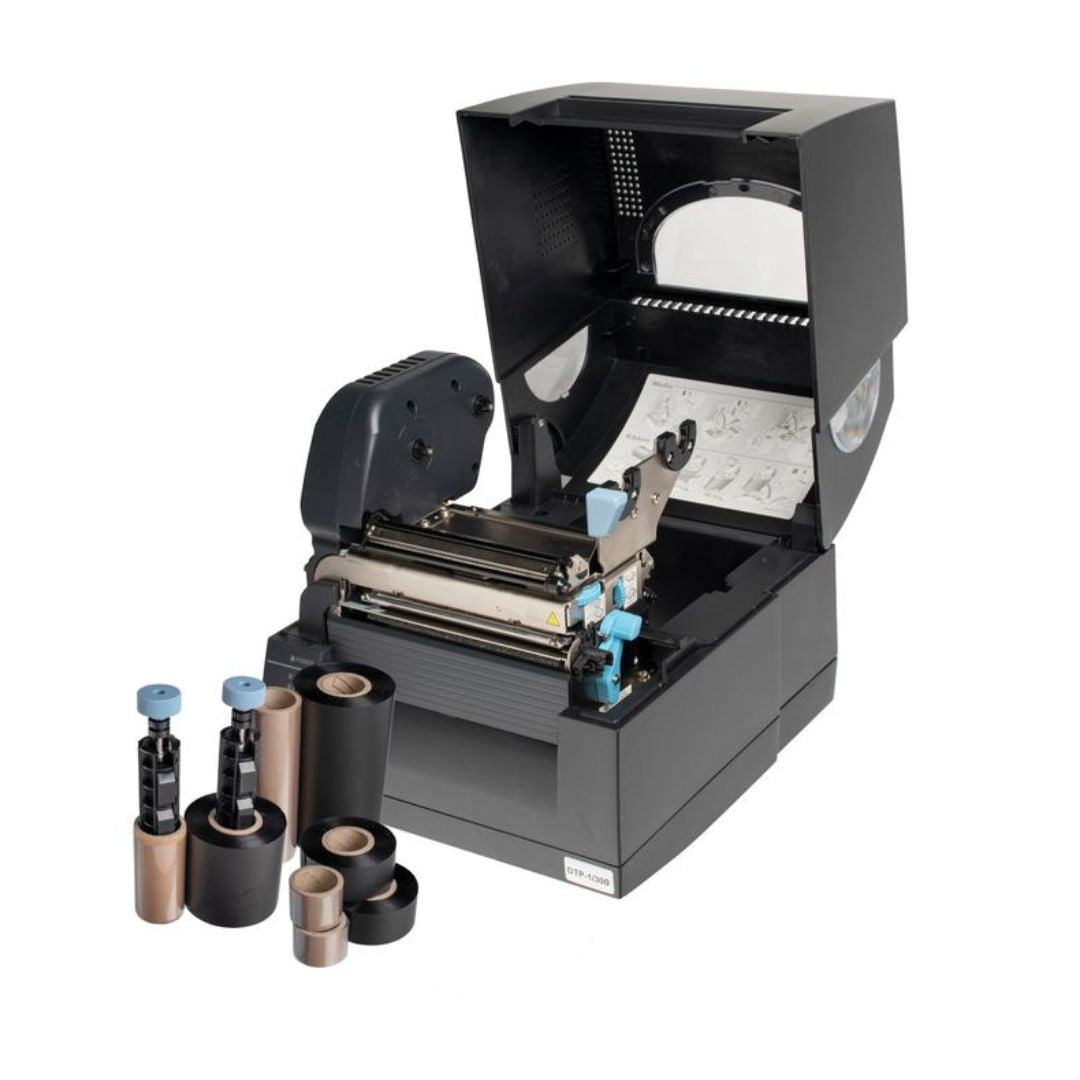
Silver Fox® has been manufacturing cable labels and labelling systems in the UK since 1979. The Fox-in-a-Box® printer system prints over 160 label types using one software, one printer, and one ribbon, with free lifetime support and training included.
Speak to Our Labelling Team
Whether you need help choosing the right cable labels for a specific environment, or you want a walkthrough of the Fox-in-a-Box® system, our UK-based team is here to help. We offer free remote training and ongoing support to get you up and running quickly.
Contact our expert team at [email protected] or call +44 (0) 1707 37 37 27.